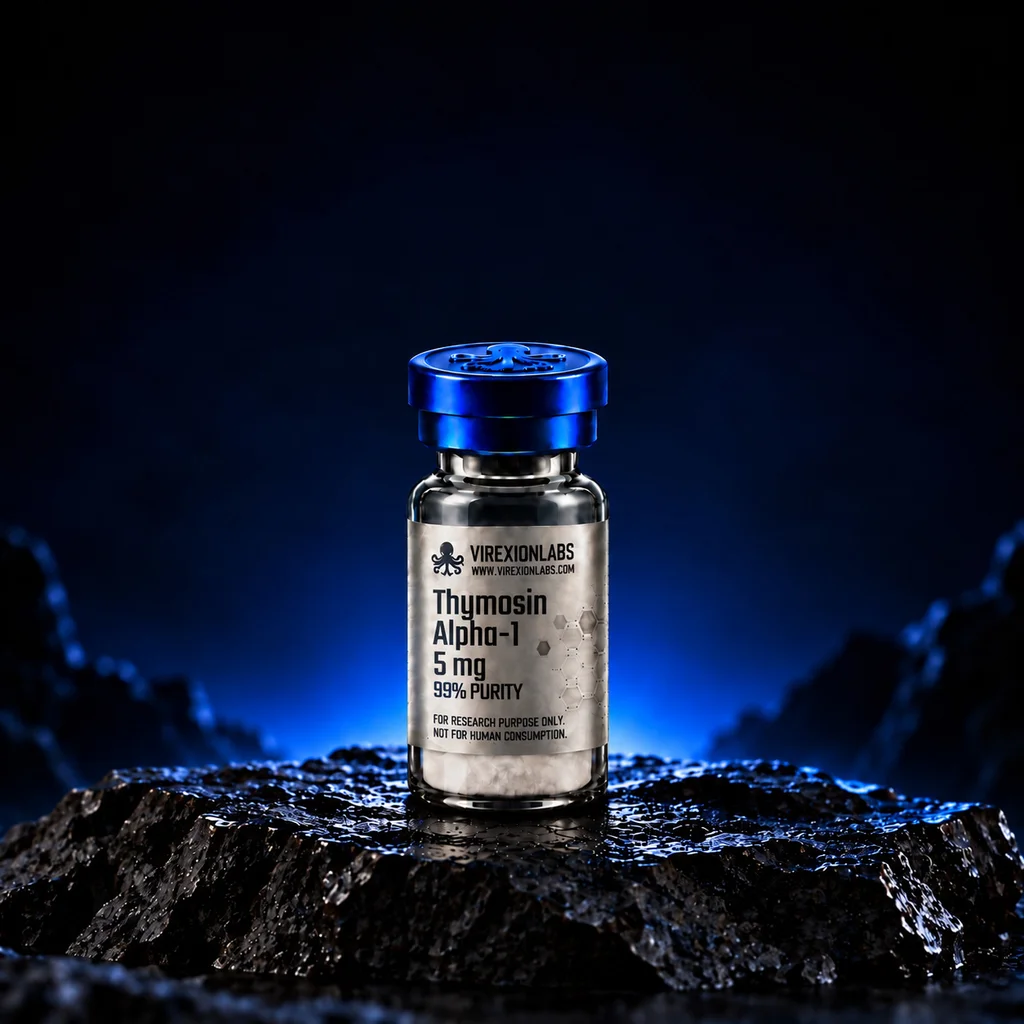
| Contents per vial | 5 mg |
|---|---|
| Form | Lyophilized powder |
| Packaging | Sealed glass vial |
| Purity | 99,25 % |
| Storage | 2–8 °C, keep dry and protect from light |
| Molecular formula | C129H215N33O55 |
| Molecular weight | 3108,28 g/mol |
| Sequence or structure | Ac-Ser-Asp-Ala-Ala-Val-Asp-Thr-Ser-Ser-Glu-Ile-Thr-Thr-Lys-Asp-Leu-Lys-Glu-Lys-Lys-Glu-Val-Glu-Glu-Glu-Ala-Glu-Asn |
| CAS | 62304-98-7 |
| Intended use | For laboratory research only |
About this product
Thymosin alpha-1 is a 28-amino acid peptide derived from the thymic protein prothymosin alpha. It is being investigated as an immunomodulator affecting both the innate and adaptive immune responses. Research includes T-cells, dendritic cells, Toll-like receptors, infections and the immune response in various diseases. It is used as a drug in specific indications in some countries, but the regulatory status varies. Its influence on immune signaling is particularly important for laboratory research.
What is Thymosin Alpha-1?
From a scientific perspective, Thymosin Alpha-1 is a substance classified as a synthetic peptide or peptide analog. Its experimental profile is mainly assessed through t-lymphocytes, dendritic cells, toll-like receptors, immunity to infection, while individual research questions can use different cell, tissue or organism models. Binding to target structures, subsequent signaling and changes in selected biological indicators are monitored.
Mechanism of action under investigation
Thymosin alpha-1 affects multiple immune pathways including TLR signaling, dendritic cells and T-lymphocytes.
Main areas of research
• T-lymphocytes: Thymosin Alpha-1 is being studied for the regulation of T-lymphocyte maturation, activation and function.
• Dendritic cells: Research is looking at how it affects dendritic cells, which recognize foreign structures and activate other parts of the immune response.
• Toll-like receptors: Mechanistic works are devoted to the modulation of TLR signaling, which is among the first systems for recognizing infectious stimuli.
• Immunity to infection: Thymosin Alpha-1 has been investigated as an immunomodulatory agent in various infectious contexts, with results depending on the disease and clinical protocol.
• Immune balance: Research focuses on the modulation of the immune response rather than simple “immunity enhancement”, including the regulation of cytokines and the activity of multiple cell types.
Research findings to date
Work to date on the substance Thymosin Alpha-1 are devoted to areas that include T-lymphocytes, dendritic cells, Toll-like receptors, immunity to infection, immune regulation. Results should be assessed according to the level of evidence: cell and animal models. Research includes T-cells, dendritic cells, Toll-like receptors, infections and the immune response in various diseases. Its influence on immune signaling is particularly important for laboratory research.