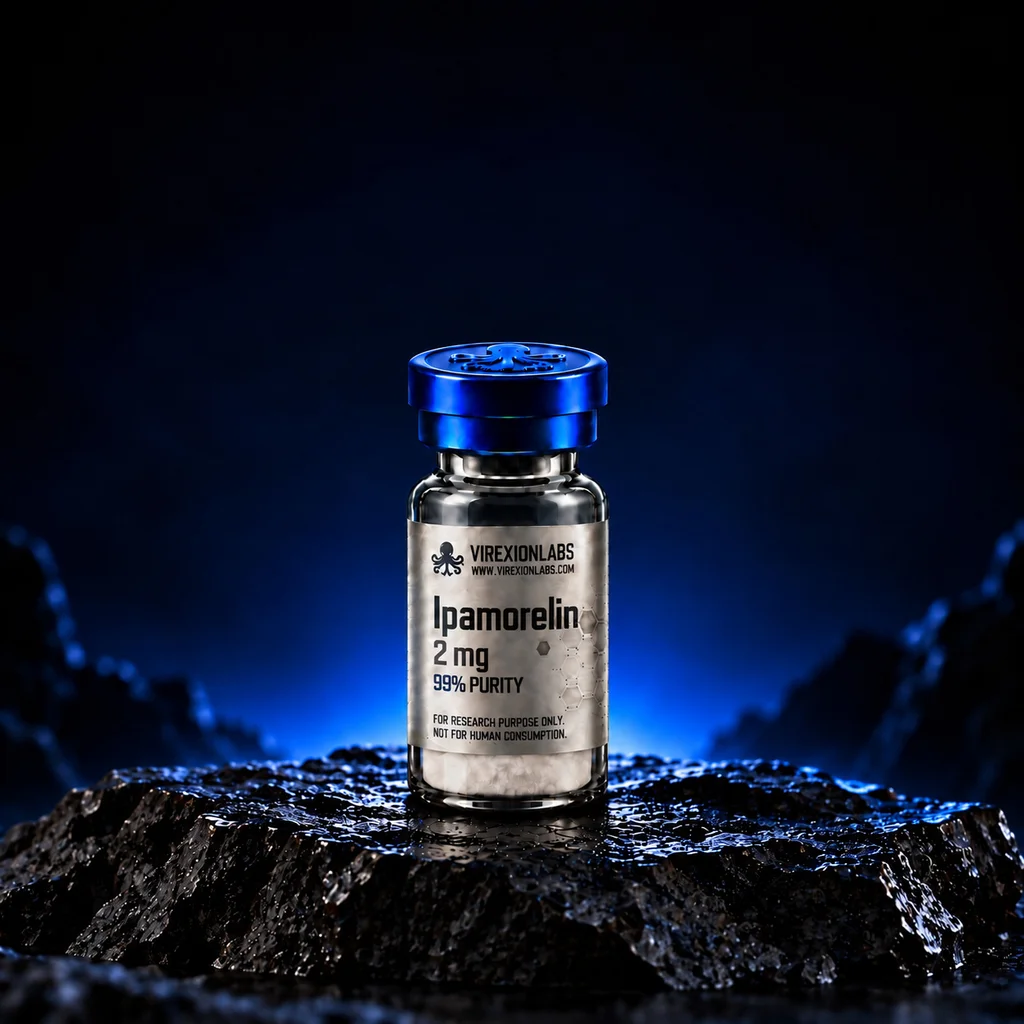
| Contents per vial | 2 mg |
|---|---|
| Form | Lyophilized powder |
| Packaging | Sealed glass vial |
| Purity | 99 % (HPLC) |
| Storage | 2–8 °C, keep dry and protect from light |
| Molecular formula | C38H49N9O5 |
| Molecular weight | 711,85 g/mol |
| Sequence or structure | Aib–His–D-2-Nal–D-Phe–Lys–NH2 |
| CAS | 170851-70-4 |
| Intended use | For laboratory research only |
About this product
Ipamorelin is a selective growth hormone secretagogue and an agonist of the ghrelin receptor GHS-R1a. It is being investigated mainly for its ability to stimulate the pulsed release of growth hormone. Compared to older GHRPs, it was designed with a higher selectivity towards the GH response. Research therefore focuses on the growth hormone–IGF-1 axis, body composition and metabolic processes.
What is IPAMORELIN?
IPAMORELIN is characterized in this portfolio as a synthetic peptide or peptide analog intended for controlled laboratory investigation. Scientific interest focuses on growth hormone release, the GH/IGF-1 axis, body composition and metabolism, regeneration and tissue processes, and related biochemical or receptor processes. Changes in predetermined markers, functional responses and signaling pathways are compared in experimental protocols.
Mechanism of action under investigation
Ipamorelin activates the ghrelin receptor GHS-R1a in the pituitary-hypothalamic system and thus promotes the secretion of growth hormone.
MAIN AREAS OF RESEARCH
• Growth hormone release: Ipamorelin is a selective GHSR-1a ghrelin receptor agonist and is being investigated for its ability to stimulate pulsatile growth hormone release.
• GH/IGF-1 axis: Research examines how increased GH secretion subsequently affects IGF-1 and other indicators of the growth hormone axis.
• Hormonal response selectivity: Ipamorelin is also being investigated for a different hormonal stimulation profile compared to older GHRPs, particularly in relation to cortisol and prolactin.
• Metabolic and tissue processes: Processes associated with the GH/IGF-1 axis, for example nutrient metabolism and tissue regeneration, are secondarily monitored; direct clinical data for these outcomes are limited.
Research findings to date
Work to date with IPAMORELIN has focused on areas including growth hormone release, the GH/IGF-1 axis, body composition and metabolism, regeneration and tissue processes. Research therefore focuses on the growth hormone–IGF-1 axis, body composition and metabolic processes. Clinical safety data are limited.
For substances that stimulate the growth hormone axis, research monitors side effects such as headache, changes in appetite, fluid retention, administration site reactions and hormonal changes.