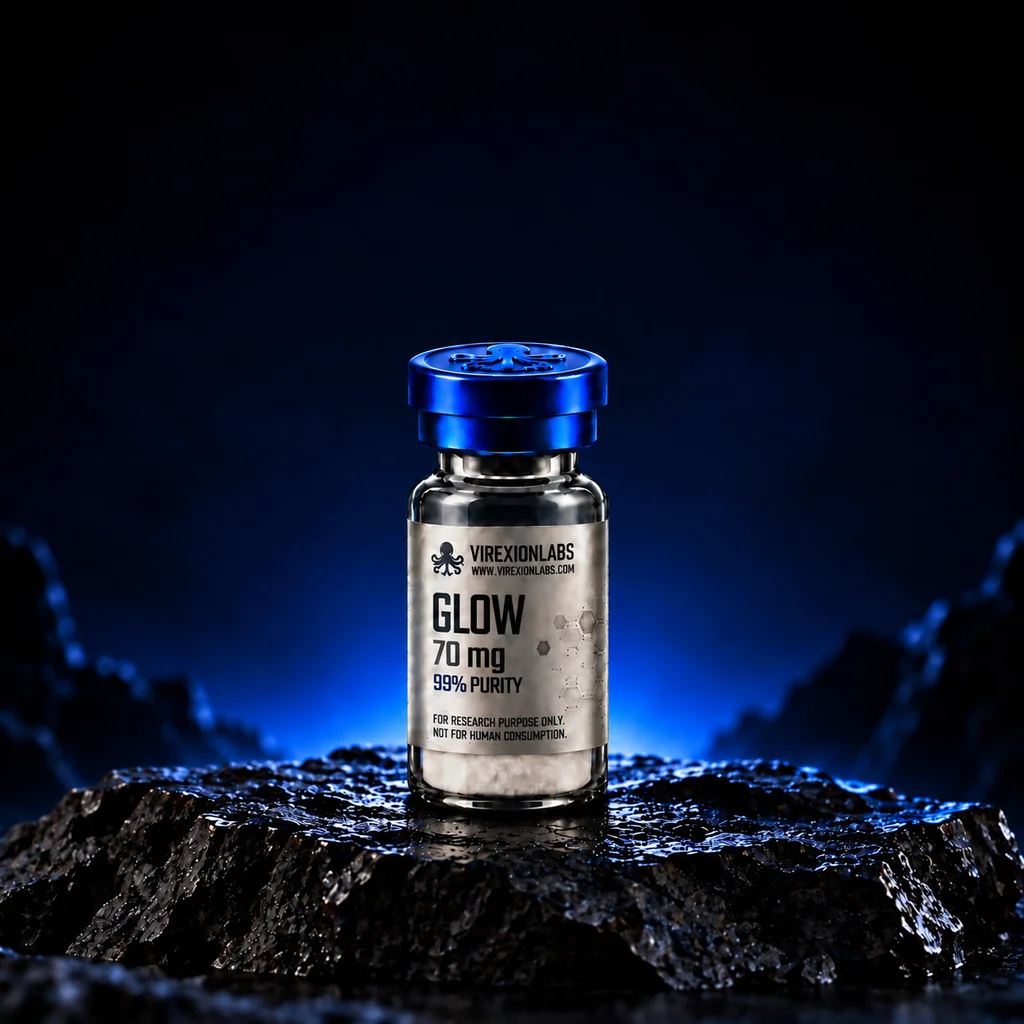
| Contents per vial | 70 mg |
|---|---|
| Blend composition | GHK-Cu 50 mg + BPC-157 10 mg + TB-500 10 mg |
| Form | Lyophilized powder |
| Packaging | Sealed glass vial |
| Purity | High purity, research grade- 99,87 % |
| Storage | 2–8 °C, keep dry and protect from light |
| Molecular formula | Blend |
| Molecular weight | Blend |
| Sequence or structure | GHK-Cu: Gly–His–Lys (GHK) in a coordination complex with copper(II). BPC-157: GEPPPGKPADDAGLV. TB-500: Ac–LKKTETQ; N-acetylated thymosin beta-4 fragment, amino acids 17–23 |
| CAS | GHK-Cu: 89030-95-5; BPC-157: 137525-51-0; TB-500: 885340-08-9 |
| Intended use | For laboratory research only |
About this product
GLOW is a multi-component research blend combining GHK-Cu, BPC-157 and TB-500. The individual components are investigated separately, especially in connection with tissue regeneration, cell migration, collagen and skin matrix. GLOW is not a single new molecule, but a joint formulation of three chemically distinct peptides.
What is GLOW?
GLOW is the name for a research mixture of three separate peptides – GHK-Cu, BPC-157 and TB-500. The research interest is based on the different properties of the individual components: GHK-Cu is investigated for skin matrix and collagen, BPC-157 for healing processes and TB-500 for cell migration and actin signaling. The mixture as a whole does not have its own established clinical evidence, so its description must be based on research on the individual components.
MAIN AREAS OF RESEARCH
• Regeneration and remodeling of tissues: The mixture combines BPC-157 and TB-500, which are separately studied in the processes of cell migration, healing and remodeling of damaged tissue, with GHK-Cu studied in the restoration of the extracellular matrix.
• Collagen and skin matrix: GHK-Cu is being studied for its effect on fibroblasts, collagen, elastin and other structural components of the skin, therefore this area is a significant part of the research profile of the GLOW mixture.
• Soft tissue healing: BPC-157 and TB-500 have separate preclinical literature targeting tendons, wounds and other soft tissues. GLOW combines these substances in one research formulation, but the combination itself does not have its own controlled studies.
• Angiogenesis and cell migration: Individual components are investigated in the processes of new blood vessel formation and cell migration to the site of damage, which are important in tissue regeneration.