| Contents per vial | 10 mg |
|---|---|
| Form | Lyophilized powder |
| Packaging | Sealed glass vial |
| Purity | 99,96 % |
| Storage | 2–8 °C, keep dry and protect from light |
| Molecular formula | C228H388N86O64 |
| Molecular weight | 5358,06 g/mol |
| Sequence or structure | H-ltlrkepaseiaqsileaysqngwanrrsggkrppprrrqrrkkrg-OH |
| CAS | 2460055-10-9 |
| Intended use | For laboratory research only |
About this product
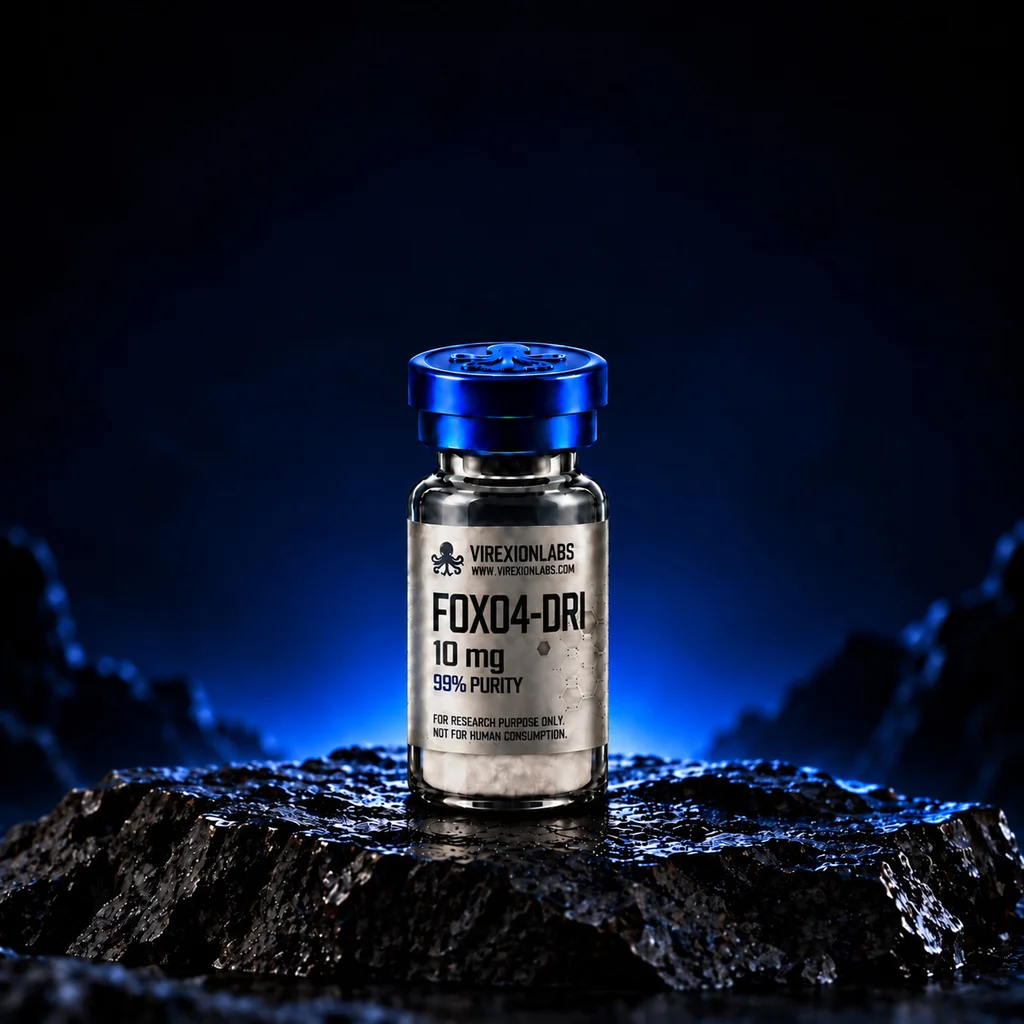
FOXO4-DRI is an experimental peptide designed to disrupt the interaction between FOXO4 and p53 in senescent cells. Preclinical research investigates whether this can selectively promote apoptosis of certain senescent cells. Interest arose in the field of senolytics and biological aging.
What is FOXO4-DRI?
FOXO4-DRI is classified as a “synthetic peptide or peptide analog” substance and is being evaluated in scientific research in areas such as senescent cells, foxo4-p53 interaction, tissue aging, senolytic research. Attention is paid to its interaction with relevant receptors, enzymes or cellular pathways and subsequent changes in measurable laboratory parameters.
Mechanism of action under investigation
FOXO4-DRI is supposed to disrupt the binding of FOXO4 to p53. In senescent cells, this can shift p53 and promote the apoptotic program; this mechanism is preclinical.
MAIN AREAS OF RESEARCH
• Senescent cells: FOXO4-DRI was designed to investigate cells that have stopped dividing but remain metabolically active and can affect the surrounding tissue.
• FOXO4–p53 interaction: The peptide disrupts the binding interaction between FOXO4 and p53, which in senescent cells helps keep p53 outside the mechanisms leading to cell death.
• Senolytic research: Preclinical work investigates the selective elimination of a subset of senescent cells and subsequent changes in tissue function.
• Tissue aging: Research evaluates whether reducing the burden of senescent cells affects age-related organ changes; clinical data in humans are still lacking.
Research findings to date
Results should be judged according to the level of evidence: cellular and animal. Preclinical research investigates whether this can selectively promote apoptosis of certain senescent cells.