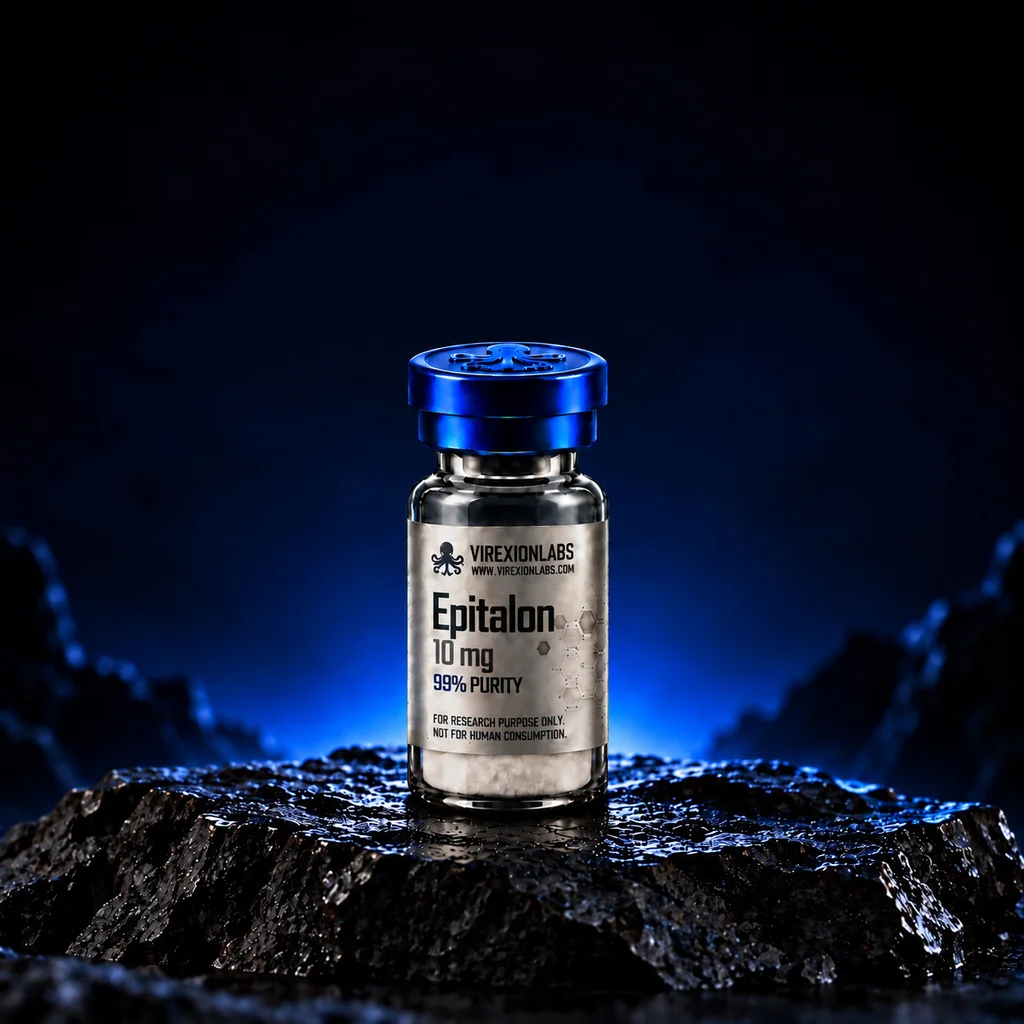
| Contents per vial | 10 mg |
|---|---|
| Form | Lyophilized powder |
| Packaging | Sealed glass vial |
| Purity | 99,63 % |
| Storage | 2–8 °C, keep dry and protect from light |
| Molecular formula | C14H22N4O9 |
| Molecular weight | 390,35 g/mol |
| Sequence or structure | Ala–Glu–Asp–Gly (AEDG) |
| CAS | 307297-39-8 |
| Intended use | For laboratory research only |
About this product
Epitalon is a synthetic tetrapeptide Ala-Glu-Asp-Gly studied mainly in relation to cellular aging, telomeres and circadian regulation. It is often referred to as an “anti-aging” peptide, but most of the evidence comes from preclinical or regionally published studies. Experimental work examines telomerase activity, telomere length and gene expression. Research on melatonin and the pineal gland is also interesting.
What is Epitalon?
Epitalon is classified as a “synthetic peptide or peptide analogue” and is evaluated in scientific research in relation to areas such as telomeres and telomerase, cellular aging, circadian regulation, oxidative stress. Attention is paid to its interaction with relevant receptors, enzymes or cellular pathways and subsequent changes in measurable laboratory parameters.
Mechanism of action under investigation
Proposed mechanisms include changes in gene expression and telomerase activity.
MAIN AREAS OF RESEARCH
• Telomeres and telomerase: Epitalon is being studied in cell models for its effect on telomerase activity and telomeres, which protect the ends of chromosomes.
• Cellular aging: Research is tracking changes associated with replicative aging of cells and their ability to maintain normal function.
• Circadian regulation: Some works investigate the relationship of Epitalon to melatonin and the biological rhythms that control the body’s daily cycle.
• Oxidative stress: Experimental models evaluate antioxidant mechanisms and protection of cells against damage by reactive oxygen species.
• Gene expression: Research includes changes in gene activity related to aging and cellular regulation; human clinical evidence is limited.
Research findings to date
Results should be judged according to the level of evidence: cellular and animal. It is often referred to as an “anti-aging” peptide, but most of the evidence comes from preclinical or regionally published studies. Research on melatonin and the pineal gland is also interesting.