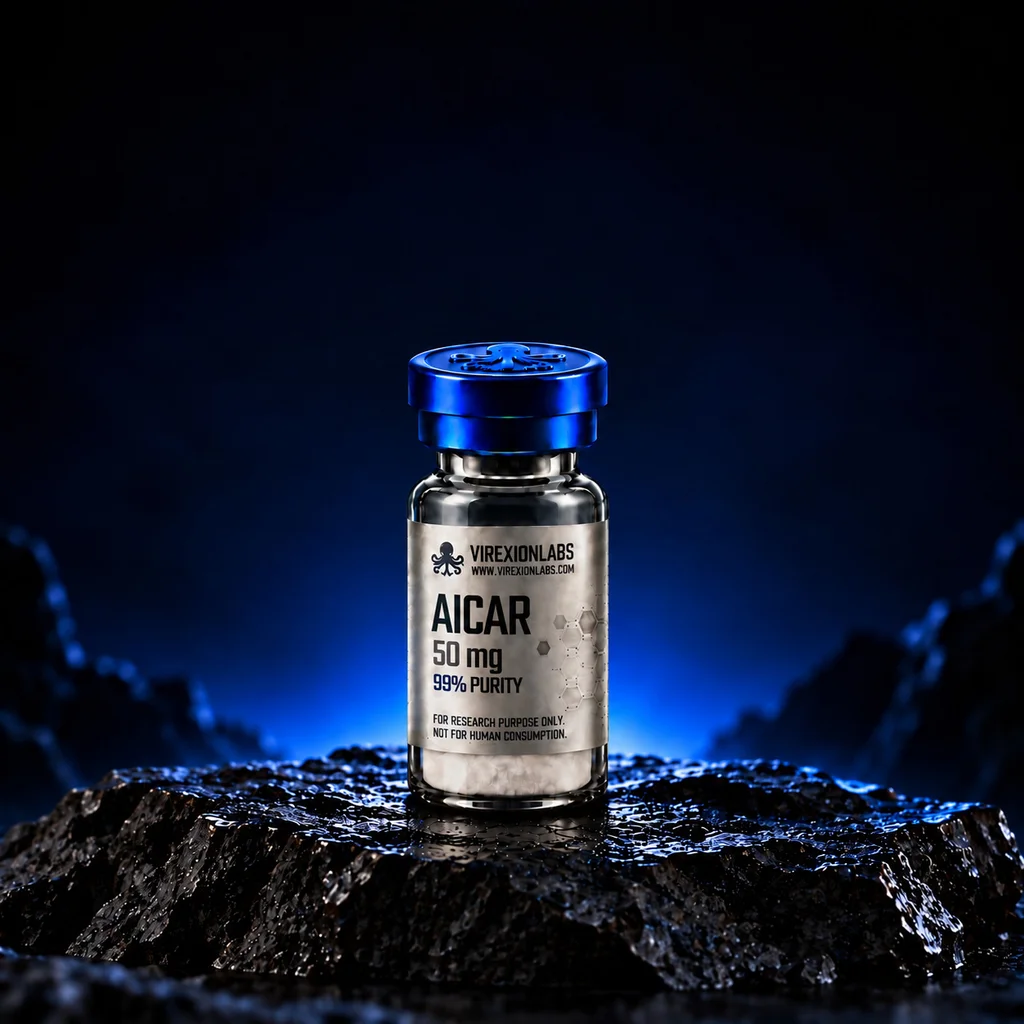
| Contents per vial | 50 mg |
|---|---|
| Form | Lyophilized powder |
| Packaging | Sealed glass vial |
| Purity | 99,99 % |
| Storage | 2–8 °C, keep dry and protect from light |
| Molecular formula | C9H14N4O5 |
| Molecular weight | 258,23 g/mol |
| CAS | 2627-69-2 |
| Intended use | For laboratory research only |
About this product
AICAR – is an experimental purine compound mainly used to activate AMPK. AMPK is a key cellular sensor of energy status, therefore AICAR is used in research on glucose metabolism, fatty acid metabolism and mitochondrial adaptation. It is also known for physical performance experiments and “exercise mimetic” mechanisms.
What is AICAR?
From a scientific perspective, AICAR represents a substance classified as a small synthetic molecule. Its experimental profile is mainly assessed through AMPK, glucose metabolism, fatty acid oxidation, mitochondrial adaptation, while individual research questions can use different cell, tissue or organismal models. Binding to target structures, subsequent signaling and changes in selected biological indicators are monitored.
Mechanism of action under investigation
AICAR is converted in cells to ZMP, an AMP analog that can activate AMPK and thereby alter energy metabolism. It also has AMPK-independent effects.
MAIN AREAS OF RESEARCH
• Activation of AMPK: AICAR is converted in cells to ZMP, which mimics the energy signal of AMP and activates AMPK – the main sensor of low energy availability.
• Glucose metabolism: Research is looking at how AMPK activation changes the uptake and use of glucose, especially in skeletal muscle.
• Fatty acid oxidation: AICAR is used to investigate the switch of metabolism towards higher utilization of fatty acids as an energy source.
• Mitochondrial adaptation: Prolonged AMPK activation is being investigated in relation to the formation and functional adaptation of mitochondria.
• Endurance adaptation: Preclinical models investigate metabolic changes similar to part of the adaptive response to endurance exercise; AICAR is not a peptide.
Research findings to date
Results should be assessed according to the level of evidence: cell and animal models. AMPK is a key cellular sensor of energy status, therefore AICAR is used in research on glucose metabolism, fatty acid metabolism and mitochondrial adaptation. Most such results are preclinical.