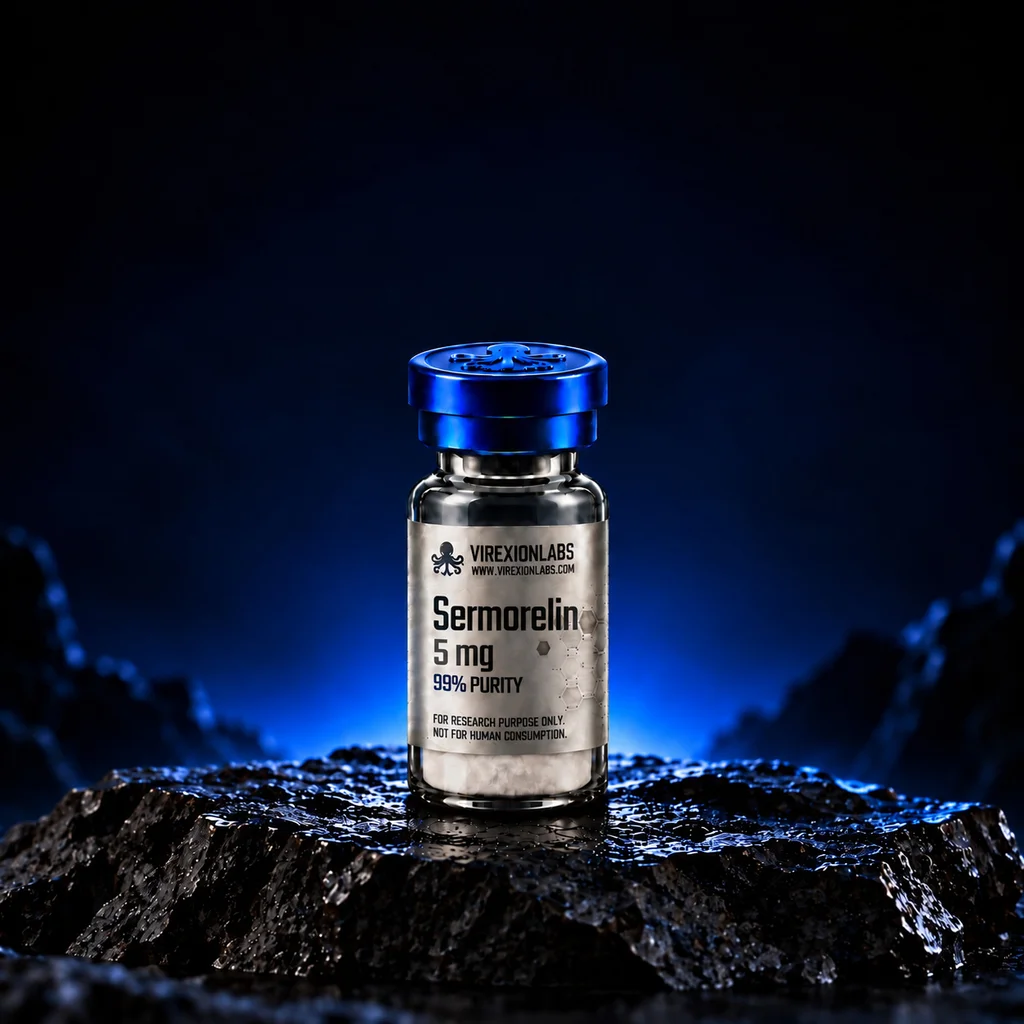
| Contents per vial | 5 mg |
|---|---|
| Form | Lyophilized powder |
| Packaging | Sealed glass vial |
| Purity | 99 % (HPLC) |
| Storage | 2–8 °C, keep dry and protect from light |
| Molecular formula | C149H246N44O42S |
| Molecular weight | 3357,90 g/mol |
| Sequence or structure | H-Tyr-Ala-Asp-Ala-Ile-Phe-Thr-Asn-Ser-Tyr-Arg-Lys-Val-Leu-Gly-Gln-Leu-Ser-Ala-Arg-Lys-Leu-Leu-Gln-Asp-Ile-Met-Ser-NH2 (GHRH(1–29)NH2) |
| CAS | 86168-78-7 |
| Intended use | For laboratory research only |
About this product
Sermorelin is supplied as a lyophilised powder in a sealed, nitrogen-flushed glass vial with a bromobutyl stopper and a flip-off aluminium cap. Placeholder text. Batch-specific identity, purity and analytical documentation have not been entered for this item yet. Replace this description with your own verified text and attach the certificate of analysis for the batch printed on the label before publishing. This material is sold for laboratory research only. It is not a medicine, a food supplement or a cosmetic, and no guidance on human or animal administration is provided.Sermorelin is a 29-amino acid analogue of the natural active part of GHRH. It is being investigated for its ability to stimulate the pituitary gland to release its own growth hormone. Unlike direct administration of GH, it uses the physiological GHRH pathway. Research focuses on GH pulsatility, IGF-1 levels, and hypothalamic–pituitary axis function.
What is Sermorelin?
Sermorelin is classified as a “synthetic peptide or peptide analogue” and is evaluated in scientific research in relation to areas such as growth hormone secretion, GH/IGF-1 axis, pituitary function, physiological GH pulsatility. Attention is paid to its interaction with relevant receptors, enzymes or cellular pathways and subsequent changes in measurable laboratory parameters.
Mechanism of action under investigation
Sermorelin binds to GHRH receptors of pituitary somatotropic cells and activates cAMP signaling leading to the release of growth hormone.
MAIN AREAS OF RESEARCH
• Growth hormone secretion: Sermorelin is an analog of natural GHRH and is being studied for stimulating the pituitary gland to release its own growth hormone.
• GH/IGF-1 axis: Research follows subsequent changes in growth hormone and IGF-1 as the main indicators of the activity of this hormonal axis.
• Pituitary function: Sermorelin has also historically been used as a tool to assess the pituitary’s ability to respond to GHRH stimulation.
• GH pulsatility: Since it acts through the physiological GHRH receptor, its effect on the natural pulsatile nature of growth hormone release is being investigated.
Research findings to date
Work to date on the substance Sermorelin are devoted to areas that include growth hormone secretion, GH/IGF-1 axis, pituitary function, physiological pulsatility of GH. Results should be assessed according to the level of evidence: cell and animal models. In the case of substances affecting the growth hormone axis, for example, reactions at the site of administration, headache, changes in appetite, fluid retention and hormonal changes are monitored in the research.