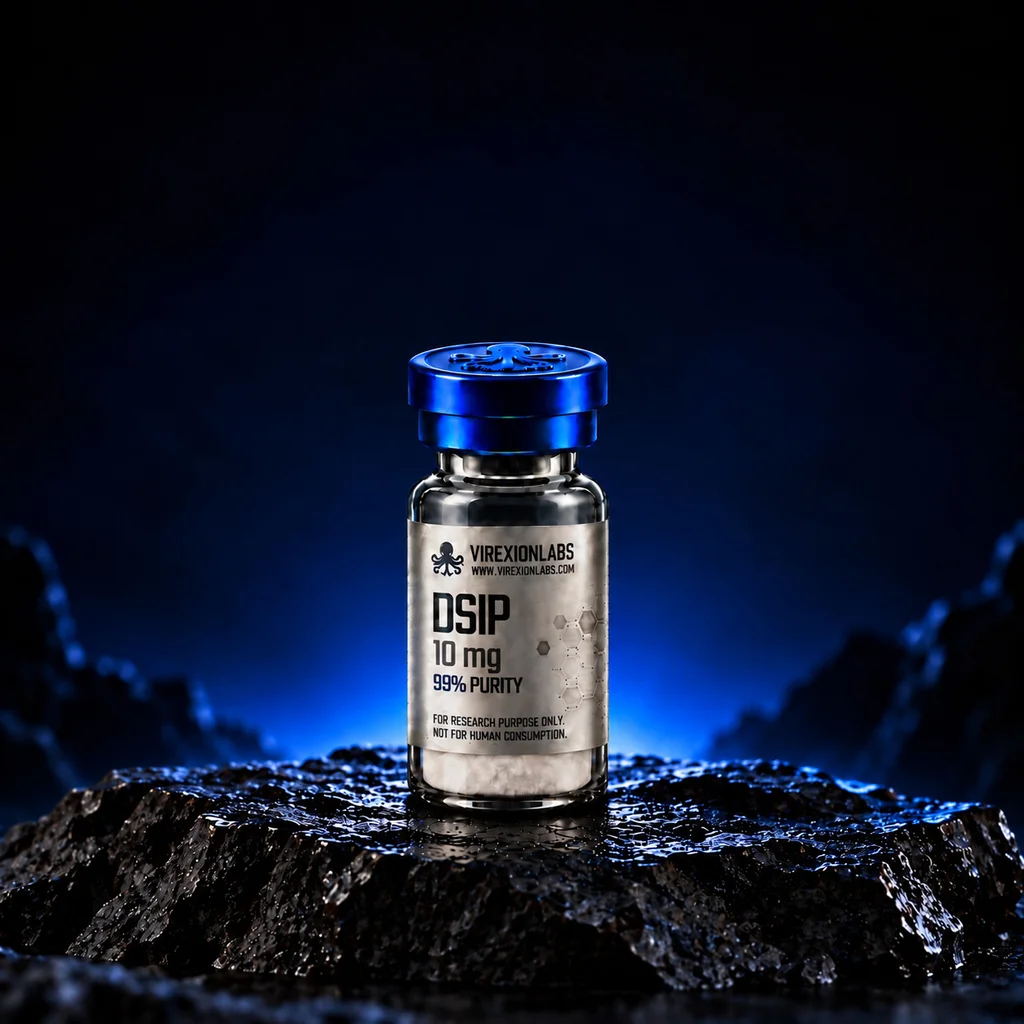
| Contents per vial | 10 mg |
|---|---|
| Form | Lyophilized powder |
| Packaging | Sealed glass vial |
| Purity | 99,48 % (HPLC) |
| Storage | 2–8 °C, keep dry and protect from light |
| Molecular formula | C35H48N10O15 |
| Molecular weight | 848,81 g/mol |
| Sequence or structure | Trp–Ala–Gly–Gly–Asp–Ala–Ser–Gly–Glu (WAGGDASGE) |
| CAS | 62568-57-4 |
| Intended use | For laboratory research only |
About this product
DSIP, delta sleep-inducing peptide, is a short peptide historically investigated for a possible role in the regulation of sleep and the stress response. Older studies have examined sleep architecture, stress hormones, and neuroendocrine responses. Therefore, it is more suitable as an experimental neuropeptide.
What is DSIP?
From a scientific perspective, DSIP represents a substance classified as a synthetic peptide or peptide analog. Its experimental profile is mainly assessed through sleep architecture, stress response, EEG and sleep phases, neuroendocrine regulation, while individual research questions can use different cell, tissue or organism models. Binding to target structures, subsequent signaling and changes in selected biological indicators are monitored.
MAIN AREAS OF RESEARCH
• Sleep and its architecture: DSIP has historically been investigated for possible associations with sleep, its stages and electrophysiological changes during rest.
• EEG and sleep stages: Research includes EEG monitoring, duration of individual sleep stages and transitions between wakefulness and sleep.
• Stress response: Experimental work also investigated changes in the neuroendocrine response to stress and adaptation of the organism to stress.
• Neuroendocrine regulation: DSIP has been associated with multiple hormonal and nervous systems, but results are mixed and the biological role of the peptide remains unclear.
Research findings to date
Work to date on DSIP covers areas including sleep architecture, stress response, EEG and sleep phases, neuroendocrine regulation. Results should be assessed according to the level of evidence: cell and animal models.