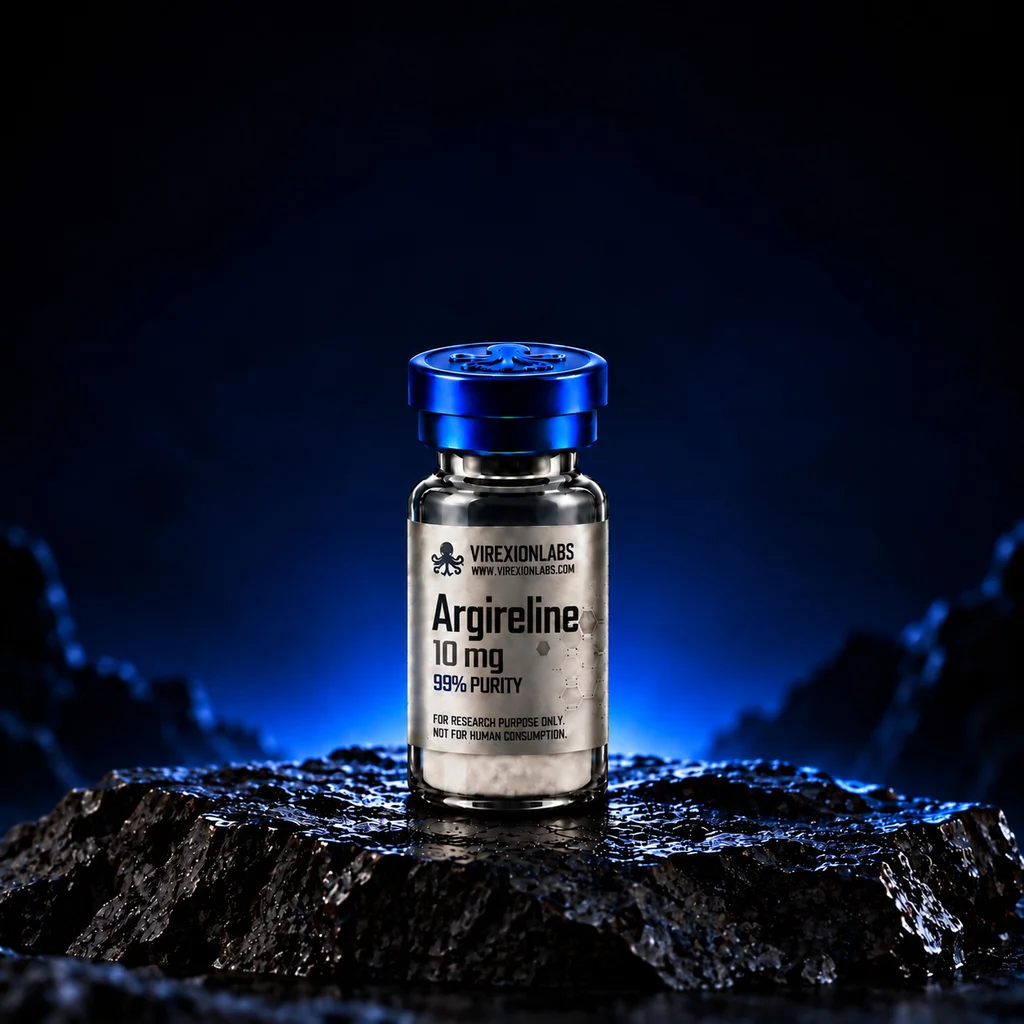
| Contents per vial | 10 mg |
|---|---|
| Form | Lyophilized powder |
| Packaging | Sealed glass vial |
| Purity | 99,86 % |
| Storage | 2–8 °C, keep dry and protect from light |
| Molecular formula | C34H60N14O12S |
| Molecular weight | 888,99 g/mol |
| Sequence or structure | Ac–Glu–Glu–Met–Gln–Arg–Arg–NH2 (Ac–EEMQRR–NH2); acetyl hexapeptide-8 |
| CAS | 616204-22-9 |
| Intended use | For laboratory research only |
About this product
Argireline, chemically acetyl hexapeptide-8, is a cosmetic peptide investigated for temporarily affecting muscle contraction mechanisms in the skin. It is often referred to as a “botox-like” peptide, but it does not work in the same way or with the same intensity as botulinum toxin. Research focuses on facial wrinkles and the SNARE-complex related to the release of neurotransmitters. It is mainly intended for cosmetic research.
What is Argireline?
Argireline is classified as a “synthetic peptide or peptide analog” substance and is evaluated in scientific research in connection with areas such as facial wrinkles, SNARE signaling, muscle contraction, cosmetic anti-aging. Attention is paid to its interaction with relevant receptors, enzymes or cellular pathways and subsequent changes in measurable laboratory parameters.
Mechanism of action under investigation
Acetyl hexapeptide-8 mimics part of SNAP-25 and may interfere with SNARE complex assembly. The effect is significantly milder and different from botulinum toxin.
MAIN AREAS OF RESEARCH
• Expression wrinkles: Argireline, acetyl hexapeptide-8, is studied in cosmetics mainly for changes in the appearance of wrinkles caused by repeated movement of the facial muscles.
• SNARE signaling: The peptide was designed as a fragment of the SNAP-25 protein and is being investigated for interference with the SNARE complex required for neurotransmitter release.
• Muscle contraction: Research is devoted to the local reduction of signals involved in the contraction of superficial facial expression muscles without the use of botulinum toxin.
• Cosmetic anti-aging use: Smaller topical studies evaluate the depth of wrinkles and skin appearance; the results cannot be confused with the effect of injectable neuromodulators.
Research findings to date
Results should be assessed according to the level of evidence: cell and animal models. Research focuses on facial wrinkles and the SNARE-complex related to the release of neurotransmitters. It is mainly intended for cosmetic research.