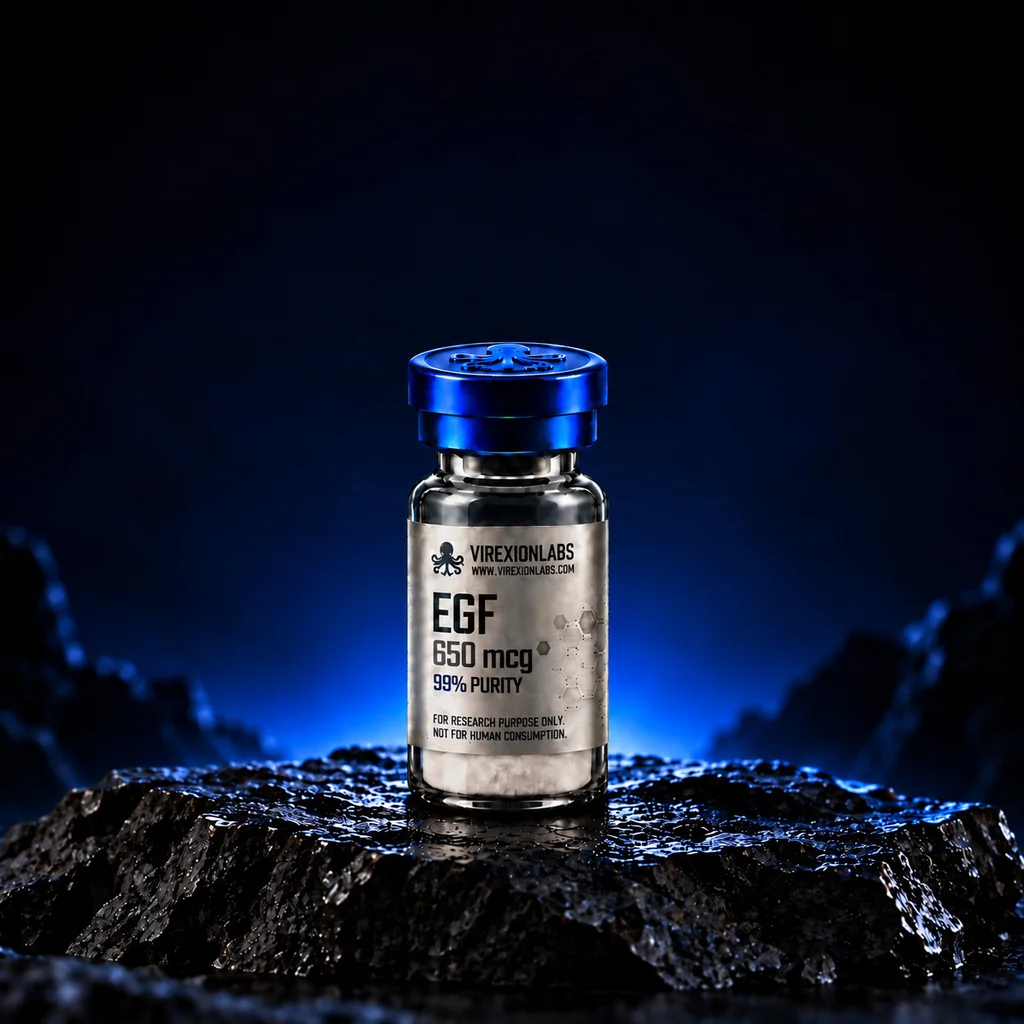
| Contents per vial | 650 µg |
|---|---|
| Form | Lyophilized powder |
| Packaging | Sealed glass vial |
| Purity | 97 % |
| Storage | 2–8 °C, keep dry and protect from light |
| Molecular formula | C270H401N73O83S7 |
| Molecular weight | approximately 6222 g/mol |
| Sequence or structure | NSDSECPLSHDGYCLHDGVCMYIEALDKYACNCVVGYIGERCQYRDLKWWELR |
| CAS | 62253-63-8 |
| Intended use | For laboratory research only |
About this product
EGF is a natural growth factor that stimulates cell proliferation and differentiation through the EGF receptor. Research focuses on epithelial tissues, wound healing, skin and cell signaling. EGF is also an essential laboratory tool in cell cultures.
What is EGF – Epidermal Growth Factor?
EGF – Epidermal Growth Factor is characterized in this portfolio as a recombinant growth factor / polypeptide intended for controlled laboratory research. Scientific interest is focused on epithelial cell proliferation, wound healing, skin, cell cultures and related biochemical or receptor processes.
Mechanism of action under investigation
EGF binds to the EGFR receptor, triggering its dimerization and tyrosine kinase activity. Subsequently, it activates the MAPK/ERK, PI3K/AKT pathways and other systems regulating cell growth and survival.
MAIN AREAS OF RESEARCH
• Epithelial cell growth: EGF activates the EGFR receptor and triggers signals promoting epithelial cell division and migration.
• Wound healing: Research is looking at how EGF promotes keratinocyte migration and tissue resurfacing during the healing process.
• Skin regeneration: EGF is being studied in relation to epidermal renewal, keratinocyte-fibroblast communication and the skin’s response to damage.
• Cell cultures: In laboratories, EGF is commonly used as a growth factor to promote and study the proliferation of EGFR-expressing cells.