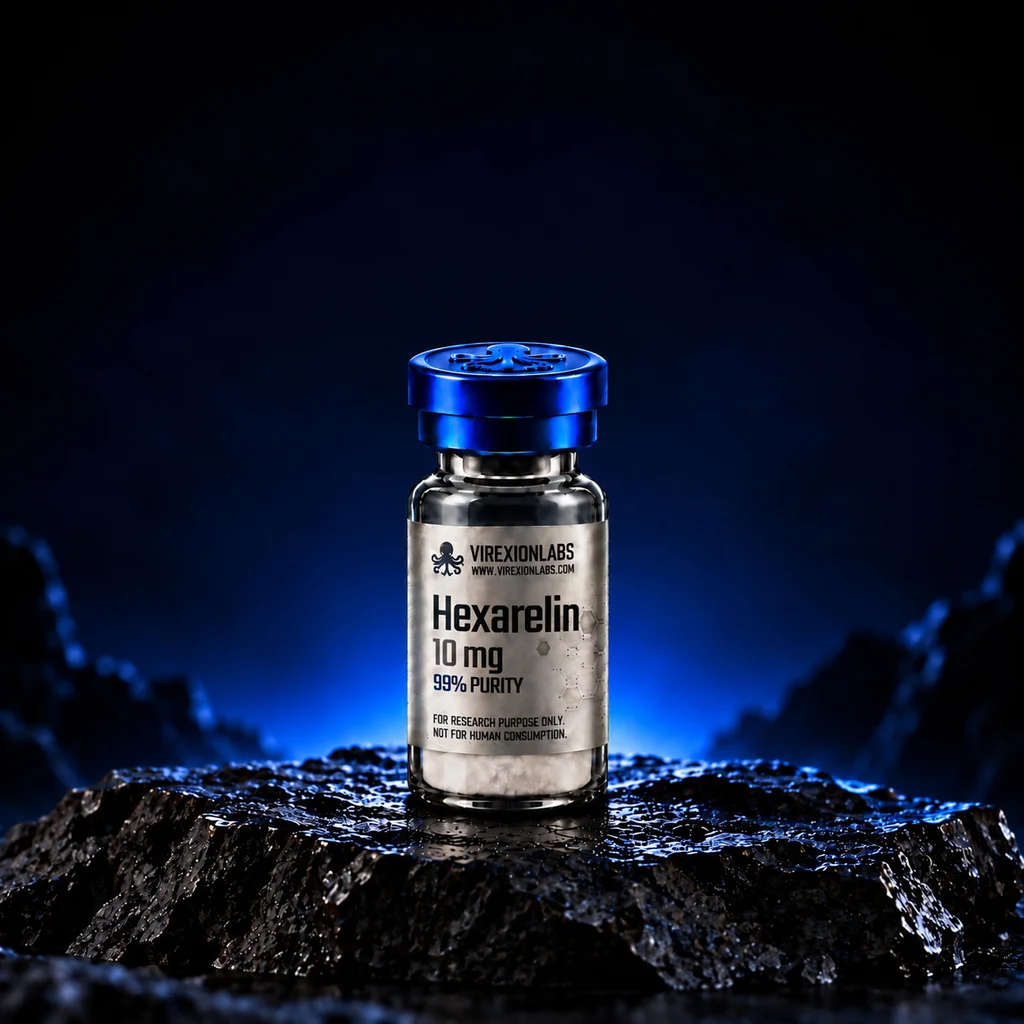
| Contents per vial | 10 mg |
|---|---|
| Form | Lyophilized powder |
| Packaging | Sealed glass vial |
| Purity | 99,25 % |
| Storage | 2–8 °C, keep dry and protect from light |
| Molecular formula | C47H58N12O6 |
| Molecular weight | 887,04 g/mol |
| Sequence or structure | His–D-Trp(2-Me)–Ala–Trp–D-Phe–Lys–NH2 |
| CAS | 140703-51-1 |
| Intended use | For laboratory research only |
About this product
Hexarelin is a synthetic growth hormone secretagogue from the GHRP group. It activates the ghrelin receptor and elicits a significant GH response in human studies. Research is devoted to the GH/IGF-1 axis, neuroendocrine regulation and also experimental cardiovascular effects. It is not completely selective and can also affect prolactin or cortisol. Therefore, it is suitable as a pharmacological tool for the study of GHS receptors.
What is Hexarelin?
From a scientific perspective, Hexarelin is a substance classified as a synthetic peptide or peptide analogue. Its experimental profile is mainly assessed through growth hormone secretion, GH/IGF-1 axis, cardiovascular research, neuroendocrine response, while individual research questions can use different cell, tissue or organism models. Binding to target structures, subsequent signaling and changes in selected biological indicators are monitored.
Mechanism of action under investigation
Hexarelin activates GHS-R1a and promotes GH secretion. Some experimental effects may also involve mechanisms outside the classical GH axis.
MAIN AREAS OF RESEARCH
• Growth hormone secretion: Hexarelin is a potent agonist of the ghrelin receptor GHSR-1a studied to stimulate the release of growth hormone.
• GH/IGF-1 axis: Research monitors subsequent changes in GH and IGF-1 and compares the hormonal response with other growth hormone secretagogues.
• Cardiovascular research: Experimental works have investigated the effects of Hexarelin in heart tissue and its interactions with receptors outside of the classic pituitary GH response.
• Neuroendocrine response: Hexarelin is also used to study how ghrelin signaling affects the pituitary gland and other hormonal systems.
Research findings to date
Results should be assessed according to the level of evidence: cell and animal models. Research is devoted to the GH/IGF-1 axis, neuroendocrine regulation and also experimental cardiovascular effects. In the case of substances affecting the growth hormone axis, for example, reactions at the site of administration, headache, changes in appetite, fluid retention and hormonal changes are monitored in the research.