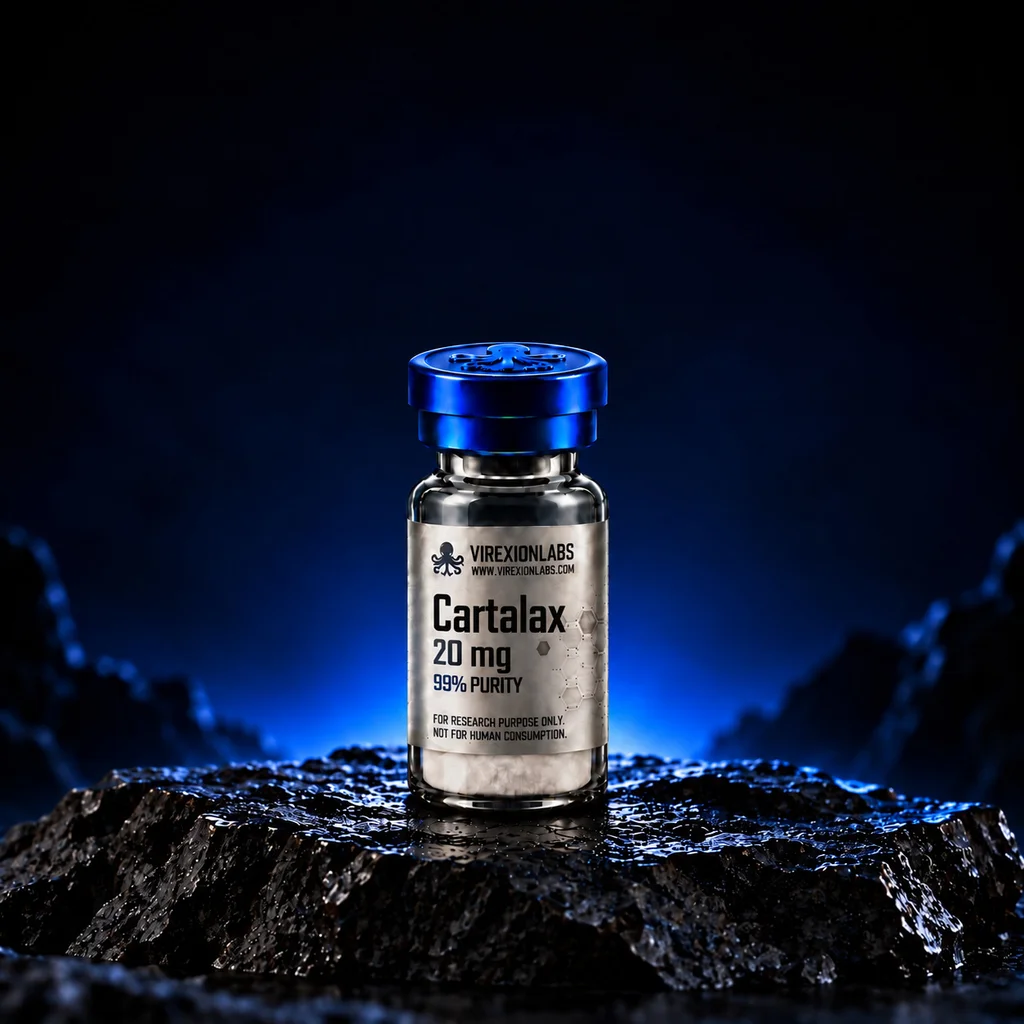
| Contents per vial | 20 mg |
|---|---|
| Form | Lyophilized powder |
| Packaging | Sealed glass vial |
| Purity | 99,65 % (HPLC) |
| Storage | 2–8 °C, keep dry and protect from light |
| Molecular formula | C12H19N3O8 |
| Molecular weight | 333,29 g/mol |
| Sequence or structure | Ala–Glu–Asp (AED) |
| CAS | 85806-95-7 |
| Intended use | For laboratory research only |
About this product
Cartalax is a short peptide bioregulator, which in the available literature is mainly associated with cartilage and connective tissue cell research. Published data are considerably more limited than for well-characterized pharmacological peptides. Research focuses on gene expression, cellular aging and chondrocyte function.
What is Cartalax?
Cartalax is classified as a “synthetic peptide or peptide analog” substance and is evaluated in scientific research in relation to areas such as chondrocytes and cartilage, gene expression, cellular aging, extracellular matrix. Attention is paid to its interaction with relevant receptors, enzymes or cellular pathways and subsequent changes in measurable laboratory parameters.
Mechanism of action under investigation
The proposed effect is described as peptide regulation of gene expression in cartilage cells.
MAIN AREAS OF RESEARCH
• Chondrocytes and Cartilage: Cartalax is described as a short peptide studied in relation to cartilage cells and cartilage tissue maintenance processes.
• Gene expression: Experimental work attributes changes in the expression of genes associated with chondrocyte function to Cartalax, but the available literature is considerably narrower than for established research peptides.
• Cellular aging: Part of the research is devoted to age-related changes in cartilage cells and their ability to maintain normal function.
• Extracellular matrix: Processes associated with collagen and other matrix components that determine the structure and mechanical properties of cartilage are investigated.