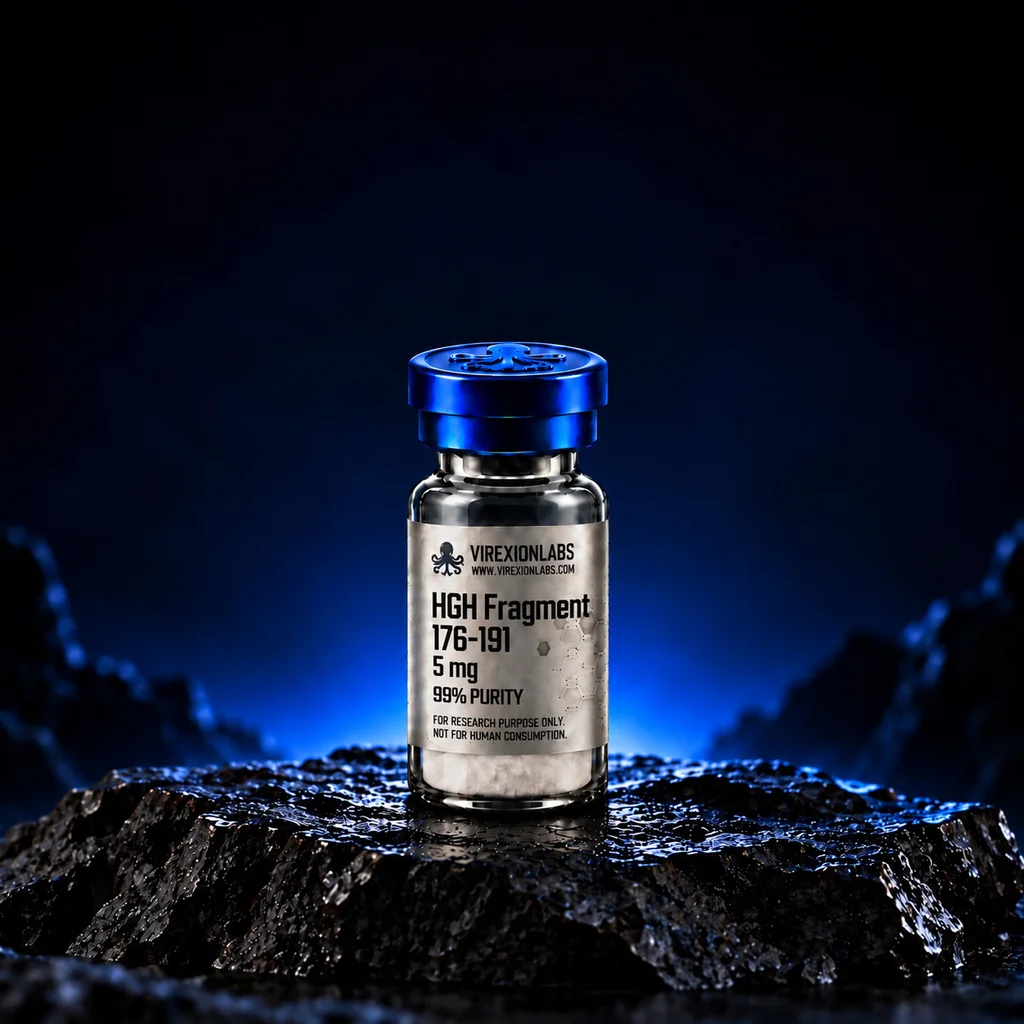
| Contents per vial | 5 mg |
|---|---|
| Form | Lyophilized powder |
| Packaging | Sealed glass vial |
| Purity | 99 % (HPLC) |
| Storage | 2–8 °C, keep dry and protect from light |
| Molecular formula | C78H123N23O22S2 |
| Molecular weight | 1799,10 g/mol |
| Sequence or structure | FLRIVQCRSVEGSCGF; disulfide bridge Cys7–Cys14 |
| CAS | 66004-57-7 |
| Intended use | For laboratory research only |
About this product
HGH Fragment 176-191 is a C-terminal fragment of human growth hormone studied mainly for its relationship to fat metabolism. Historical research has sought to separate the lipolytic effects of growth hormone from its growth and diabetogenic effects. Preclinical models therefore monitored fat breakdown, fat formation and body weight.
What is HGH Fragment 176-191?
HGH Fragment 176-191 is characterized in this portfolio as a synthetic peptide or peptide analog intended for controlled laboratory investigation. Scientific interest focuses on lipolysis, lipogenesis, body weight and fat mass, the separation of the metabolic effects of GH, and related biochemical or receptor processes.
Mechanism of action under investigation
The fragment corresponds to the part of the GH molecule associated in experimental models with lipid metabolism. It does not have the full receptor activity of intact growth hormone.
MAIN AREAS OF RESEARCH
• Fat metabolism: Fragment 176-191 is derived from the C-terminal part of growth hormone and is being investigated for metabolic signals associated with adipose tissue.
• Lipolysis: Preclinical research focuses on the mobilization of stored fats and the release of fatty acids from fat cells.
• Lipogenesis: At the same time, it is monitored whether the fragment affects the process of formation and storage of new fat in adipocytes.
• Fat mass: Animal models examine changes in fat mass and body weight.
Research findings to date
Work to date on HGH Fragment 176-191 has focused on areas including lipolysis, lipogenesis, body weight and fat mass, separating the metabolic effects of GH. Preclinical models therefore monitored fat breakdown, fat formation and body weight.