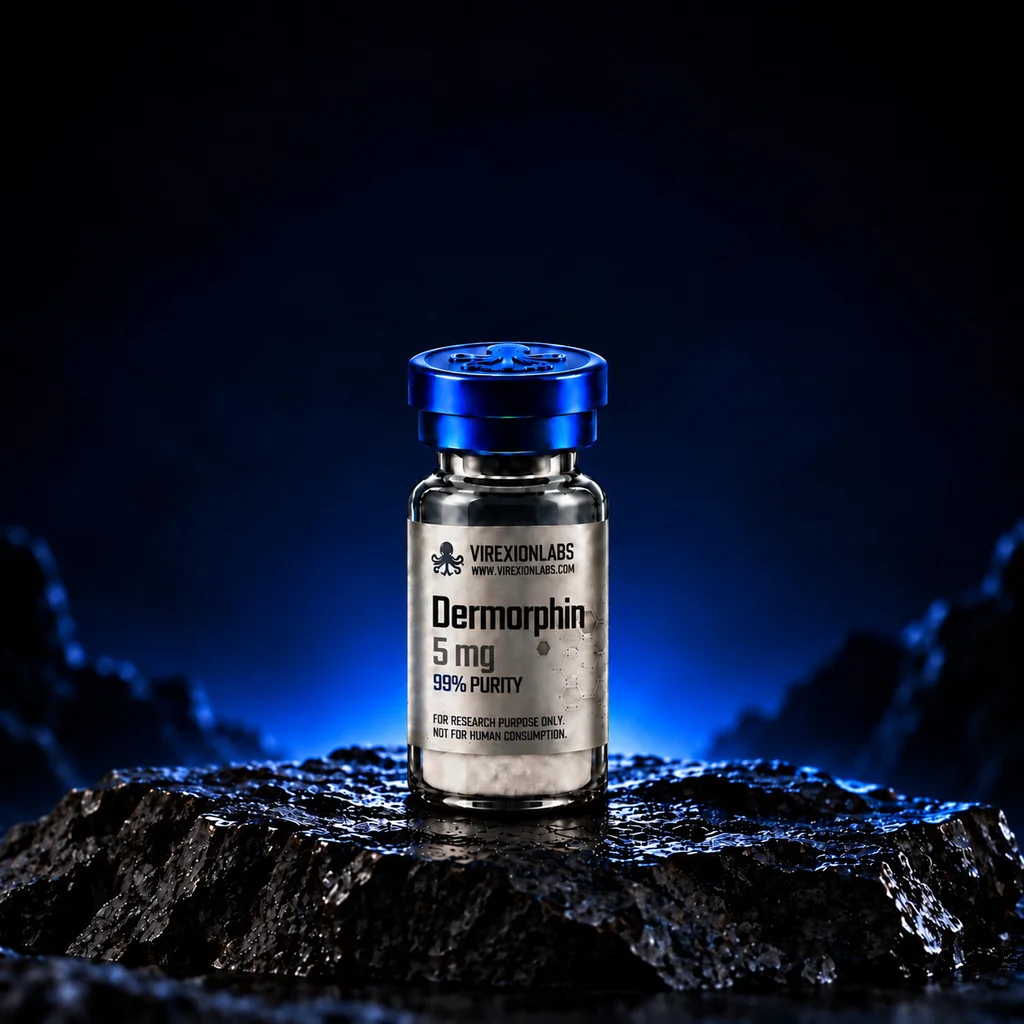

| Contents per vial | 5 mg |
|---|---|
| Form | Lyophilized powder |
| Packaging | Sealed glass vial |
| Purity | 98,9 % (HPLC) |
| Storage | 2–8 °C, keep dry and protect from light |
| Molecular formula | C27H42N6O8 |
| Molecular weight | 578,66 g/mol |
| Sequence or structure | Ac-DGGLAG-NH2 (derived from CNTF; C-terminus modified with an adamantyl group) |
| CAS | 1246751-68-7 |
| Intended use | For laboratory research only |
About this product
P21 is an experimental peptide investigated in the field of neurogenesis, learning and memory. Preclinical work links it to mechanisms derived from CNTF and to the regulation of the formation of new neurons. Research includes models of cognitive impairment and neurodegeneration. It is primarily a laboratory neurobiological tool.
What is P21?
P21 is characterized in this portfolio as a synthetic peptide or peptide analog intended for controlled laboratory investigation. Scientific interest is focused on neurogenesis, memory and learning, synaptic plasticity, neurodegenerative models and related biochemical or receptor processes. Changes in predetermined markers, functional responses and signaling pathways are compared in experimental protocols.
Mechanism of action under investigation
P21 was designed as a peptide related to CNTF signaling and is studied for its effects on neurotrophic pathways and neurogenesis.
MAIN AREAS OF RESEARCH
• Neurogenesis: P21 is being investigated for processes associated with the formation and maturation of new nerve cells, particularly in experimental brain models.
• Memory and learning: Preclinical work evaluates changes in performance in tasks focused on memory, learning and spatial orientation.
• Synaptic plasticity: Research is devoted to the formation and remodeling of connections between neurons, which are the basis of adaptation and storage of information.
• Neurodegenerative models: P21 is being investigated in models of nervous system damage and cognitive decline; the data still remain largely preclinical.
Research findings to date
. Preclinical work links it to mechanisms derived from CNTF and to the regulation of the formation of new neurons. Research includes models of cognitive impairment and neurodegeneration.