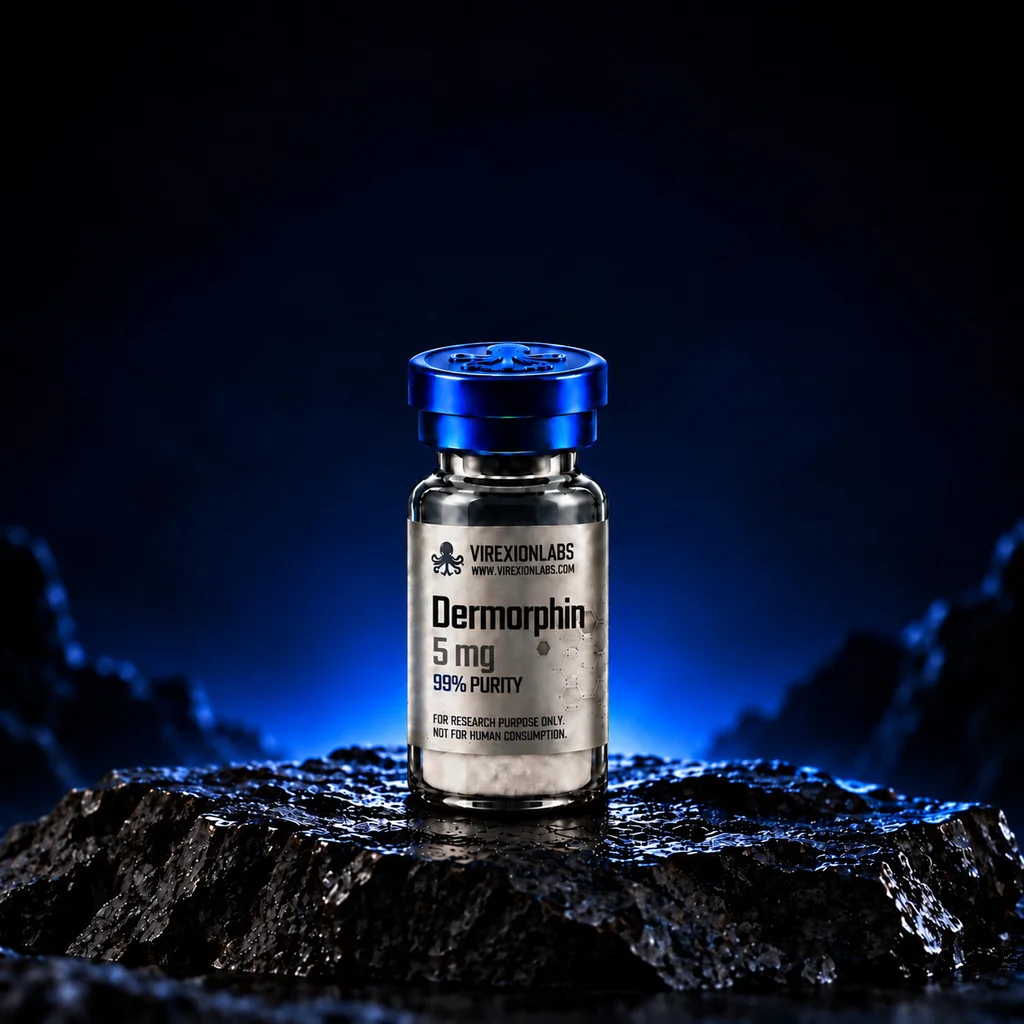
| Contents per vial | 5 mg |
|---|---|
| Form | Lyophilized powder |
| Packaging | Sealed glass vial |
| Purity | 99,36 % (HPLC) |
| Storage | 2–8 °C, keep dry and protect from light |
| Molecular formula | C40H50N8O10 |
| Molecular weight | 802,87 g/mol |
| Sequence or structure | Tyr–D-Ala–Phe–Gly–Tyr–Pro–Ser–NH2 |
| CAS | 77614-16-5 |
| Intended use | For laboratory research only |
About this product
Dermorphin is a naturally occurring opioid heptapeptide with high affinity for the μ-opioid receptor. It is mainly investigated as a model of highly potent opioid signaling and analgesia. Its pharmacology is significantly different from conventional research peptides and involves the risks typical of opioid agonists. Research focuses on receptor selectivity, pain and central nervous signaling.
What is Dermorphin?
From a scientific perspective, Dermorphin is a substance classified as a synthetic peptide or peptide analog. Its experimental profile is mainly assessed through the μ-opioid receptor, analgesic signaling, opioid pharmacology, while individual research questions can use different cell, tissue or organismal models. Binding to target structures, subsequent signaling and changes in selected biological indicators are monitored.
Mechanism of action under investigation
Dermorphin activates μ-opioid receptors and subsequent Gi/o-protein signaling, which dampens the transmission of pain signals and neuronal excitability.
MAIN AREAS OF RESEARCH
• μ-opioid receptor: Dermorphin is a natural peptide with high affinity for the μ-opioid receptor and is used to study its activation and receptor selectivity.
• Analgesic signaling: Research is devoted to the neural pathways by which activation of the μ-opioid receptor alters the transmission and perception of painful stimuli.
• Opioid pharmacology: Dermorphin serves as a model molecule for investigating the relationship between peptide structure, binding to opioid receptors, and biological response.
Research findings to date
Its pharmacology is significantly different from conventional research peptides and involves the risks typical of opioid agonists. Research focuses on receptor selectivity, pain and central nervous signaling.