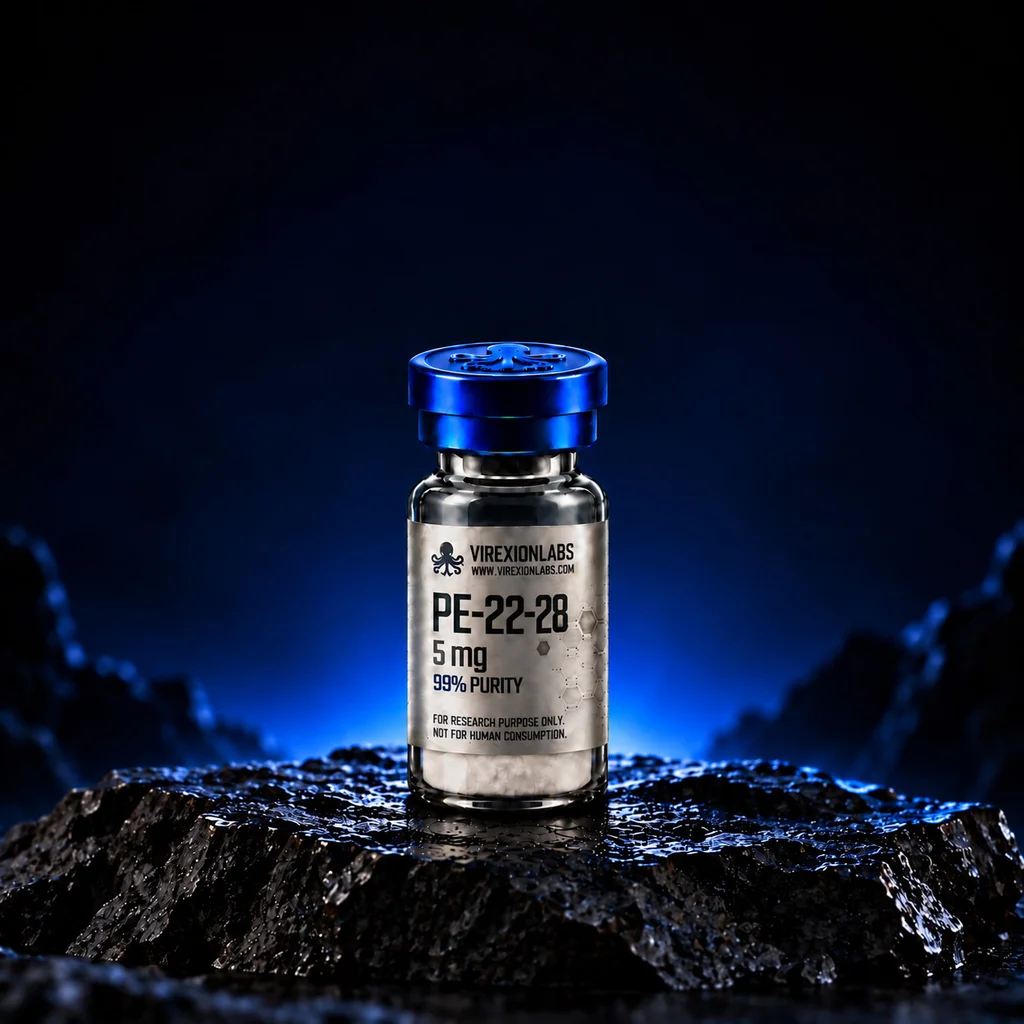
| Contents per vial | 5 mg |
|---|---|
| Form | Lyophilized powder |
| Packaging | Sealed glass vial |
| Purity | 99,98 % (HPLC) |
| Storage | 2–8 °C, keep dry and protect from light |
| Molecular formula | C35H55N11O9 |
| Molecular weight | 773,88 g/mol |
| Sequence or structure | Gly–Val–Ser–Trp–Gly–Leu–Arg (GVSWGLR) |
| CAS | 1801959-12-5 |
| Intended use | For laboratory research only |
About this product
PE-22-28 is an experimental short peptide investigated in neurobiological research, particularly in relation to mood, neuroplasticity and stress response. It is interesting as a research tool for signaling pathways associated with the nervous system.
What is PE-22-28?
From a scientific perspective, PE-22-28 represents a substance classified as a synthetic peptide or peptide analog. Its experimental profile is mainly assessed through mood and stress response, neuroplasticity, behavioral models, while individual research questions can use different cell, tissue or organism models. Binding to target structures, subsequent signaling and changes in selected biological indicators are monitored.
Mechanism of action under investigation
The proposed mechanisms are associated with neurotrophic and monoamine signaling.
MAIN AREAS OF RESEARCH
• Mood and stress response: PE-22-28 is an experimental short peptide studied mainly in behavioral models related to mood and stress response.
• Neuroplasticity: Research focuses on the processes by which neural circuits adapt to experiences and stressful stimuli.
• Behavioral models: Current knowledge comes mainly from preclinical experiments observing behavior; clinical data in humans are very limited.
Research findings to date
PE-22-28 is an experimental short peptide investigated in neurobiological research, particularly in relation to mood, neuroplasticity and stress response. It is interesting as a research tool for signaling pathways associated with the nervous system.