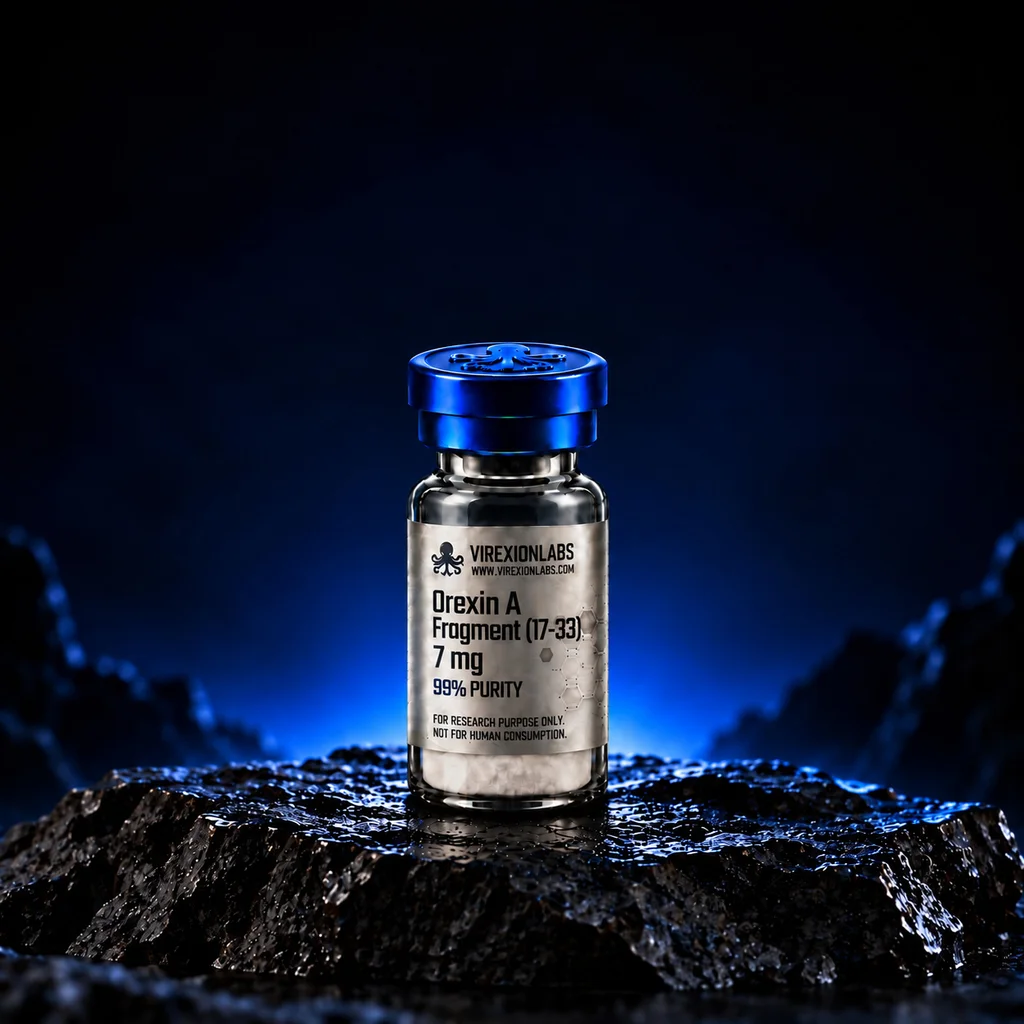
| Contents per vial | 7 mg |
|---|---|
| Form | Lyophilized powder |
| Packaging | Sealed glass vial |
| Purity | 97,48 % (HPCL) |
| Storage | 2–8 °C, keep dry and protect from light |
| Molecular formula | C79H125N23O22 |
| Molecular weight | 1749,00 g/mol |
| Sequence or structure | H-Tyr-Glu-Leu-Leu-His-Gly-Ala-Gly-Asn-His-Ala-Ala-Gly-Ile-Leu-Thr-Leu-NH2 (orexin A 17-33) |
| CAS | 343268-91-7 |
| Intended use | For laboratory research only |
About this product
Orexin A Fragment (17-33) is a fragment of orexin A, a neuropeptide closely associated with wakefulness, sleep, motivation and energy balance. However, the evidence for the specific fragment 17-33 is much narrower than for full orexin A. Therefore, it is particularly suitable for mechanistic research of the orexin system. One cannot automatically attribute to a fragment all the effects of the full molecule.
What is Orexin A Fragment (17-33)?
From a scientific perspective, Orexin A Fragment (17-33) represents a substance classified as a synthetic peptide or peptide analog. Its experimental profile is mainly assessed through wakefulness and sleep, motivation and reward, energy balance, receptor biology, while individual research questions can use different cell, tissue or organism models. Binding to target structures, subsequent signaling and changes in selected biological indicators are monitored.
Mechanism of action under investigation
Orexin A acts through OX1R and OX2R receptors.
MAIN AREAS OF RESEARCH
• Orexin receptors: Fragment 17-33 is used to investigate which parts of orexin A are required for binding and activation of OX1R and OX2R receptors.
• Wakefulness and sleep: The orexin system as a whole is crucial for maintaining wakefulness and the stability of the sleep-wake cycle; with the fragment alone, the data are narrower than with full orexin A.
• Energy balance: Research on orexin signaling involves the link between wakefulness, food intake, and energy expenditure.
• Motivation and reward: Orexin circuits are also being investigated in the brain’s motivation and reward systems, but full orexin results cannot be automatically attributed to fragment 17-33.
Research findings to date
Results should be assessed according to the level of evidence: cell and animal models. Therefore, it is particularly suitable for mechanistic research of the orexin system.