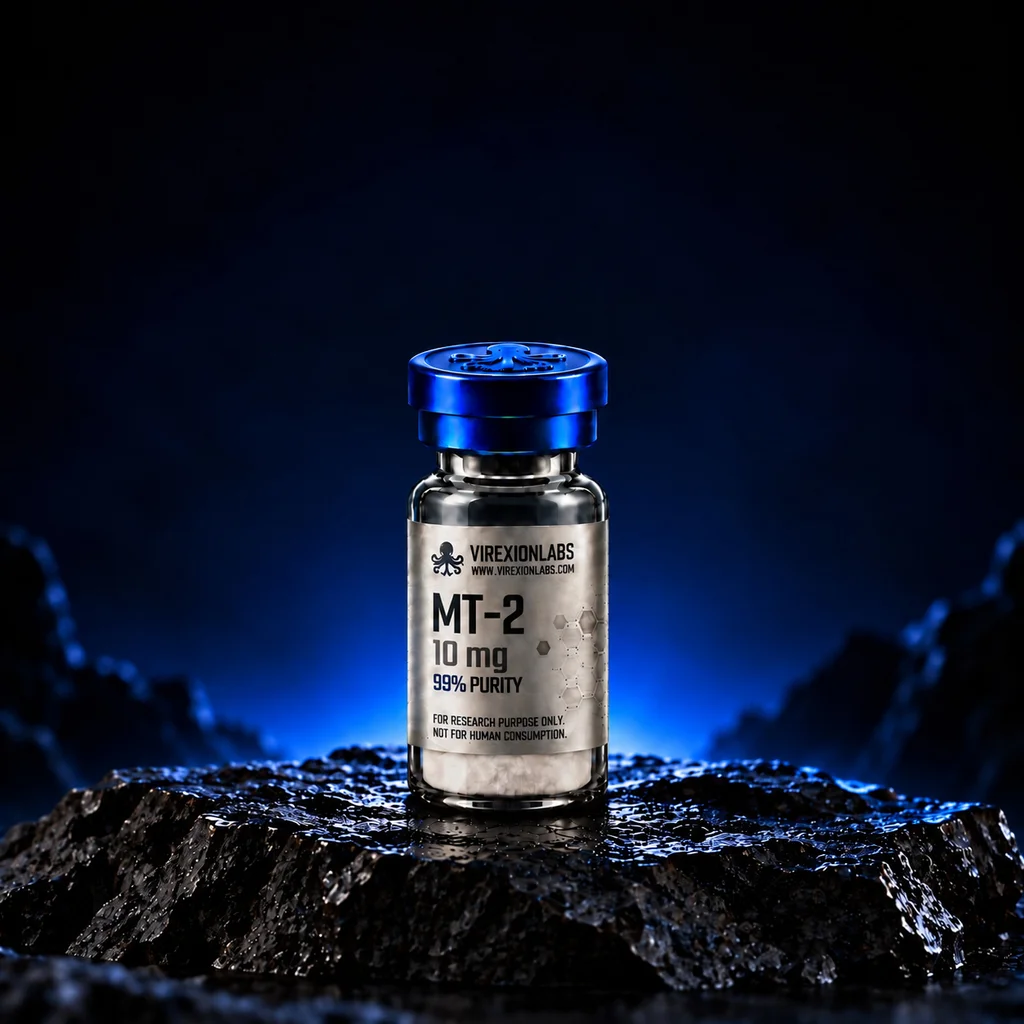
| Contents per vial | 10 mg |
|---|---|
| Form | Lyophilized powder |
| Packaging | Sealed glass vial |
| Purity | 99,97 % |
| Storage | 2–8 °C, keep dry and protect from light |
| Molecular formula | C50H69N15O9 |
| Molecular weight | 1024,18 g/mol |
| Sequence or structure | Ac–Nle–cyclo(Asp–His–D-Phe–Arg–Trp–Lys)–NH2 |
| CAS | 121062-08-6 |
| Intended use | For laboratory research only |
About this product
Melanotan II (MT-2) is a synthetic analog of α-MSH investigated for activation of melanocortin receptors. The most well-known area is the stimulation of melanogenesis, i.e. the production of melanin and skin pigmentation. However, the melanocortin system is also related to appetite, energy balance and sexual signaling.
What is MT-2 / MELANOTAN II?
From a scientific perspective, MT-2 / MELANOTAN II represents a substance classified as a synthetic peptide or peptide analog. Its experimental profile is mainly assessed through skin pigmentation, melanocortin signaling, appetite and energy balance, sexual response, while individual research questions can use different cell, tissue or organism models. Binding to target structures, subsequent signaling and changes in selected biological indicators are monitored.
Mechanism of action under investigation
MT-2 is a non-selective agonist of melanocortin receptors. Activation of MC1 promotes melanogenesis, while other melanocortin receptors are involved in central appetite regulation and neuroendocrine signaling.
MAIN AREAS OF RESEARCH
• Skin pigmentation: Melanotan II activates melanocortin receptors and is being studied to stimulate the production of melanin, the pigment responsible for skin coloration.
• Melanocortin signaling: Research uses MT-2 to investigate the MC1R, MC3R, and MC4R receptors and their roles in pigmentation, energy balance, and nerve signaling.
• Appetite and energy balance: Activation of the central melanocortin system is investigated for its effect on food intake and regulation of the organism’s energy management.
• Sexual response: MT-2 played an important role in research into melanocortin mechanisms of sexual response, which later led to the more selectively researched Bremelanotide.
Research findings to date
Work to date with MT-2 / MELANOTAN II has addressed areas including skin pigmentation, melanocortin signaling, appetite and energy balance, sexual response.
Nausea, redness, changes in pigmentation, spontaneous erections and other adverse reactions have been reported in connection with Melanotan II.