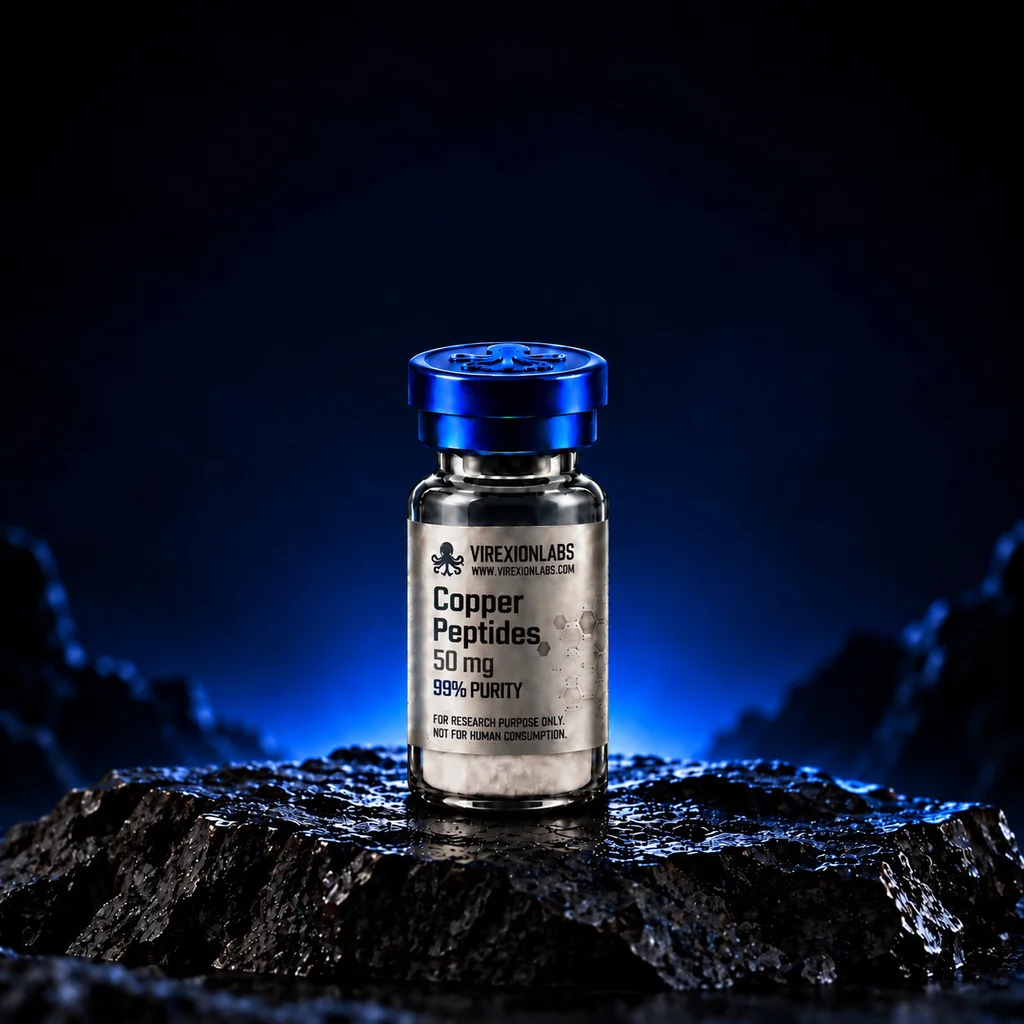
| Contents per vial | 50 mg |
|---|---|
| Form | Lyophilized powder |
| Packaging | Sealed glass vial |
| Purity | 99,94 % |
| Storage | 2–8 °C, keep dry and protect from light |
| Sequence or structure | Gly-His-Lys |
| CAS | Group designation without a single CAS number |
| Intended use | For laboratory research only |
About this product
Copper Peptides is a broader term for peptides capable of binding copper; it is not automatically one specific molecule. The most famous representative is GHK-Cu. According to the specific peptide, research is devoted to skin, collagen, healing, antioxidant processes and copper transport.
What is Copper Peptides?
Copper Peptides is classified as a “group of peptide complexes with copper” and is evaluated in scientific research in connection with areas such as collagen and extracellular matrix, healing and remodeling, skin, antioxidant enzymes. Attention is paid to its interaction with relevant receptors, enzymes or cellular pathways and subsequent changes in measurable laboratory parameters.
Mechanism of action under investigation
The peptide coordinates the copper ion and can alter its bioavailability and interactions with enzymes.
MAIN AREAS OF RESEARCH
• Collagen and extracellular matrix: Copper peptide complexes are being investigated for the transfer of copper to cellular processes associated with collagen, elastin and matrix remodeling.
• Healing and remodeling: Research is devoted to fibroblast migration, new tissue formation and matrix remodeling during healing.
• Skin: The most data exists for specific complexes, especially GHK-Cu, where elasticity, firmness and skin regeneration are monitored.
• Antioxidant enzymes: Copper is a cofactor of several enzymes, including superoxide dismutase, so the relationship of copper peptides to antioxidant protection is being investigated.
• Copper transport: The basic area is the very ability of peptides to bind copper and change its availability for cellular enzymes; results depend on the exact type of copper peptide.
Research findings to date
Results should be assessed according to the level of evidence: cell and animal models. According to the specific peptide, research is devoted to skin, collagen, healing, antioxidant processes and copper transport.