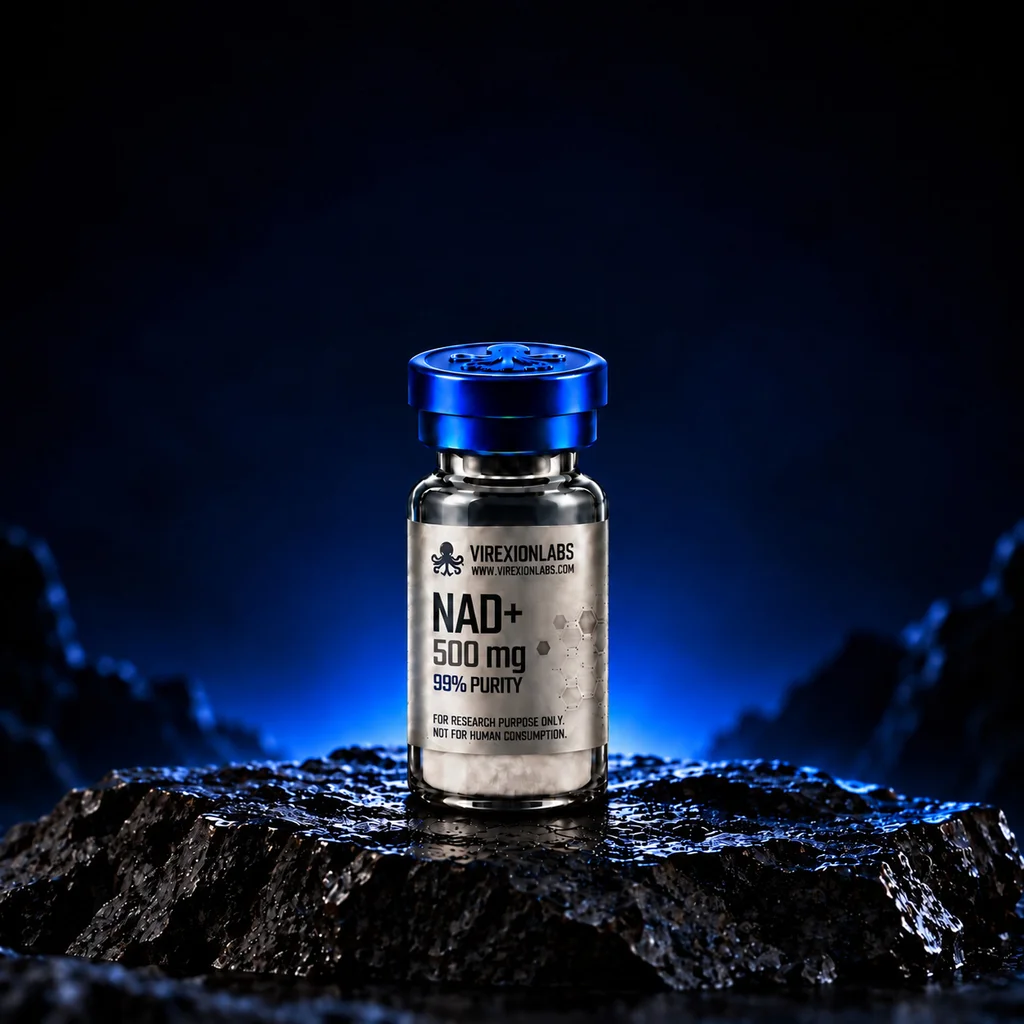
| Contents per vial | 500 mg |
|---|---|
| Form | Lyophilized powder |
| Packaging | Sealed glass vial |
| Purity | 99,96 % |
| Storage | 2–8 °C, keep dry and protect from light |
| Molecular formula | C21H27N7O14P2 |
| Molecular weight | 663,43 g/mol |
| Sequence or structure | [5-(6-aminopurin-9-yl)-3,4-dihydroxy-tetrahydrofuran-2-yl]methyl [[5-(3-carbamoylpyridin-1-ium-1-yl)-3,4-dihydroxy-tetrahydrofuran-2-yl]methoxy-hydroxy-phosphoryl] hydrogen phosphate |
| CAS | 53-84-9 |
| Intended use | For laboratory research only |
About this product
NAD+ is an essential cellular coenzyme required for energy production, redox reactions and the activity of enzymes regulating DNA repair and cellular stress. Its levels and metabolism are intensively investigated in relation to aging, mitochondria and metabolic diseases. NAD+ is essential for the conversion of nutrients into usable cellular energy. At the same time, it is a substrate for sirtuins and PARP enzymes. Research therefore covers a very broad spectrum of cell biology.
What is NAD+?
NAD+ is characterized in this portfolio as a coenzyme and redox cofactor intended for controlled laboratory investigation. Scientific interest focuses on cellular energy, mitochondrial function, aging, DNA repair and related biochemical or receptor processes
Mechanism of action under investigation
NAD+ accepts and donates electrons in metabolic reactions and also serves as a substrate for regulatory enzymes. Therefore, it links energy metabolism with DNA repair and cell signaling.
MAIN AREAS OF RESEARCH
• Cellular energy: NAD+ is a coenzyme essential for reactions in which cells convert nutrients into usable energy.
• Mitochondrial function: Research looks at how NAD+ availability affects mitochondrial respiration, redox balance and cellular energy production.
• DNA repair: NAD+ is used by PARP enzymes, which are involved in the DNA damage response and consume NAD+ during repair processes.
• Sirtuins: NAD+ is necessary for the activity of sirtuins – enzymes associated with the regulation of metabolism, stress response and gene activity.
• Cellular aging: The decline of NAD+ with age is the subject of research in relation to metabolic changes and cellular function, with results dependent on the specific tissue and model.
Research findings to date
Work to date on NAD+ has focused on areas including cellular energy, mitochondrial function, aging, DNA repair, and sirtuins.