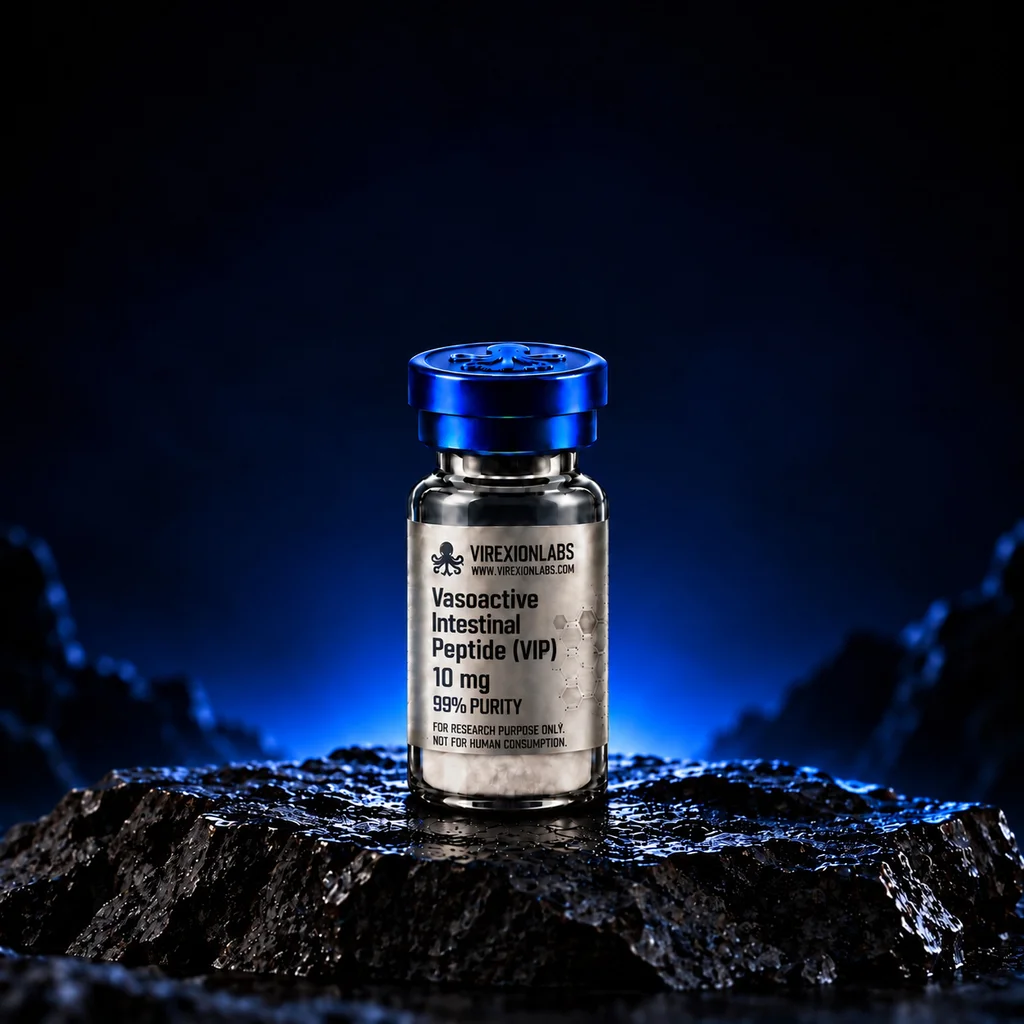
| Contents per vial | 10 mg |
|---|---|
| Form | Lyophilized powder |
| Packaging | Sealed glass vial |
| Purity | 95 % (HPLC) |
| Storage | 2–8 °C, keep dry and protect from light |
| Molecular formula | C147H238N44O42S |
| Molecular weight | 3325,83 g/mol |
| Sequence or structure | HSDAVFTDNYTRLRKQMAVKKYLNSILN–NH2; 28 amino acids |
| CAS | 40077-57-4 |
| Intended use | For laboratory research only |
About this product
VIP is a natural neuropeptide and hormone with significant effects on blood vessels, smooth muscle, digestive tract, lungs and immune signaling. Its name comes from its ability to dilate blood vessels, but its biological effect is much broader. Research focuses on inflammation, bronchomotor activity, intestinal secretion and neuroimmune communication. Since VIP acts in many organs, it is an important model of pleiotropic peptide signaling.
What is VIP – Vasoactive Intestinal Peptide?
From a scientific perspective, VIP – Vasoactive Intestinal Peptide is a substance classified as a synthetic peptide or peptide analogue. Its experimental profile is mainly assessed through vasodilation, respiratory tract, digestive tract, immune regulation, while individual research questions can use different cell, tissue or organism models. Binding to target structures, subsequent signaling and changes in selected biological indicators are monitored.
Mechanism of action under investigation
VIP activates VPAC1 and VPAC2 (and with lower affinity PAC1) receptors, which increase cAMP and alter smooth muscle activity, secretion, and immune response.
MAIN AREAS OF RESEARCH
• Vasodilation: VIP is a natural neuropeptide studied for its strong influence on the relaxation of vascular smooth muscle and the regulation of vascular tone.
• Respiratory tract: Research follows bronchodilation, mucus secretion and inflammatory processes in the lungs and airways.
• Digestive tract: VIP regulates intestinal movement, fluid secretion and communication between the nervous system and the intestinal wall.
• Immune regulation: The peptide affects the activity of several immune cells and cytokines, therefore it is studied in models of inflammatory and autoimmune processes.
• Neuroendocrine signaling: VIP functions as both a neurotransmitter and a local signal and helps to explore the link between neural, hormonal and immune regulation.
Research findings to date
Work to date on the substance VIP – Vasoactive Intestinal Peptide are devoted to areas that include vasodilation, respiratory tract, digestive tract, immune regulation, neuroendocrine signaling. Results should be assessed according to the level of evidence: cell and animal models.