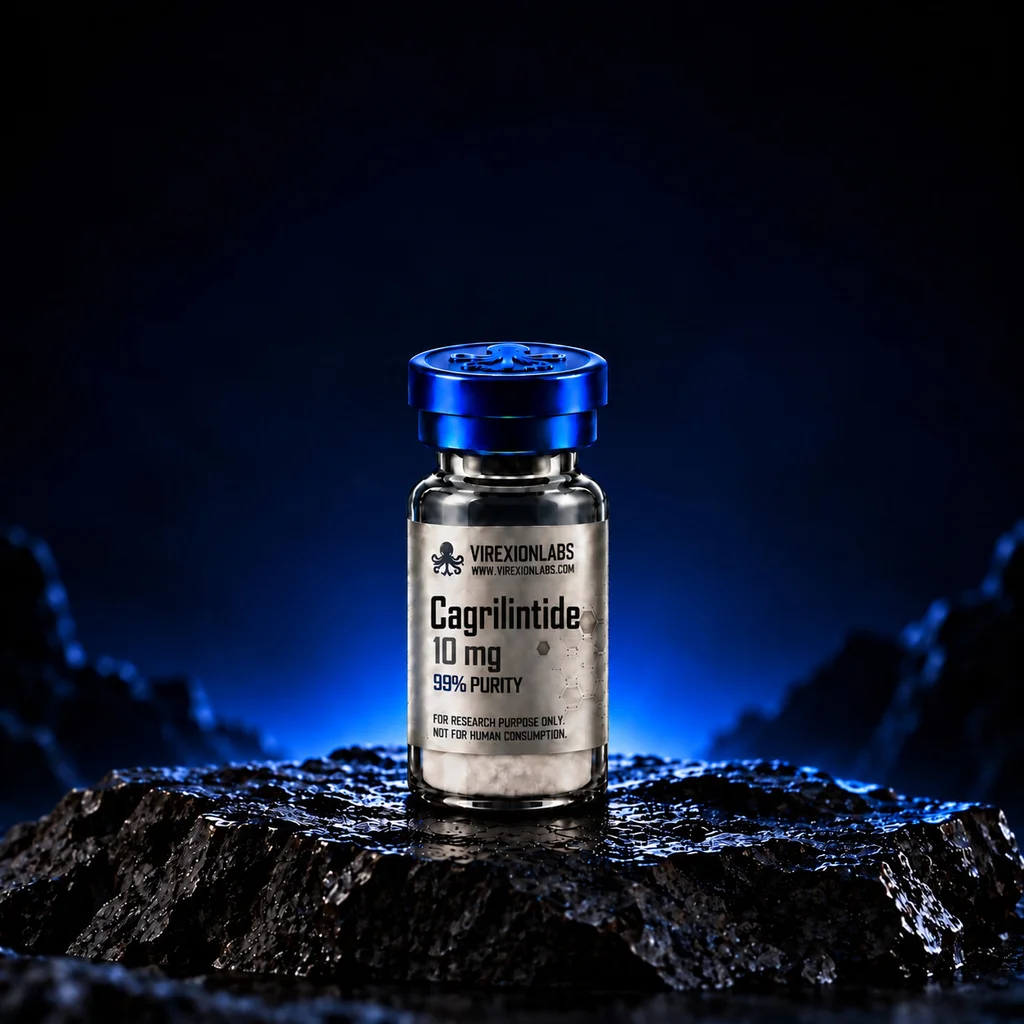
| Contents per vial | 10 mg |
|---|---|
| Form | Lyophilized powder |
| Packaging | Sealed glass vial |
| Purity | 99,97 % |
| Storage | 2–8 °C, keep dry and protect from light |
| Molecular formula | C194H312N54O59S2 |
| Molecular weight | 4409,01 g/mol |
| Sequence or structure | KCNTATCATQRLAEFLRHSSNNFGPILPPTNVGSNTP–NH2 |
| CAS | 1415456-99-3 |
| Intended use | For laboratory research only |
About this product
Cagrilintide is a long-acting amylin analog being developed for appetite and body weight regulation. Amylin is a hormone released together with insulin and is involved in satiety and control of food intake. Clinical trials are investigating cagrilintide alone and in combination with GLP-1 agonists. Research shows the potential to significantly affect weight through a different mechanism than GLP-1 drugs alone. It is an experimental molecule.
What is Cagrilintide?
From a scientific perspective, Cagrilintide represents a substance classified as a synthetic peptide or peptide analog. Its experimental profile is mainly assessed through body weight regulation, appetite reduction, food intake, combination with GLP-1 agonists, while individual research questions can use different cell, tissue or organism models. Binding to target structures, subsequent signaling and changes in selected biological indicators are monitored.
Mechanism of action under investigation
Cagrilintide activates amylin receptors in regions of the CNS involved in satiety. The extended molecular structure enables longer action compared to natural amylin.
MAIN AREAS OF RESEARCH
• Body weight regulation: Cagrilintide is a long-acting amylin analog studied for reducing energy intake and regulating body weight over the long term.
• Appetite and feeling of satiety: Amylin signaling affects the centers that regulate satiety, which is why food intake and appetite control are monitored with Cagrilintide.
• Postprandial metabolic response: Research is also looking into the role of amylin in regulating digestion and the postprandial metabolic response.
Research findings to date
Results should be assessed according to the level of evidence: cell and animal models. Clinical trials are investigating cagrilintide alone and in combination with GLP-1 agonists. Research shows the potential to significantly affect weight through a different mechanism than GLP-1 drugs alone. In clinical research of amylin analogues, the most frequently observed side effects are mainly digestive problems, such as nausea, vomiting or decreased appetite.