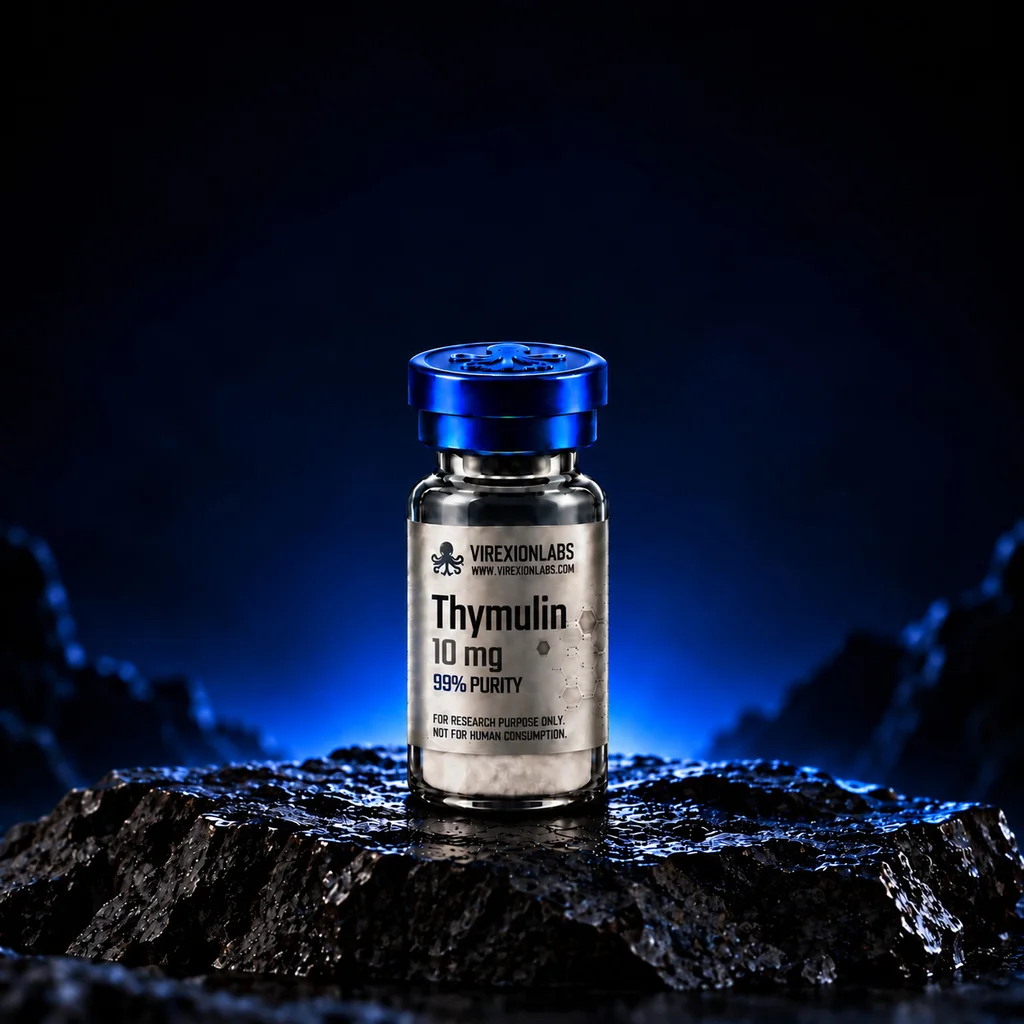
| Contents per vial | 10 mg |
|---|---|
| Form | Lyophilized powder |
| Packaging | Sealed glass vial |
| Purity | 98,72 % (HPCL) |
| Storage | 2–8 °C, keep dry and protect from light |
| Molecular formula | C33H54N12O15 |
| Molecular weight | 858,85 g/mol |
| Sequence or structure | pGlu–Ala–Lys–Ser–Gln–Gly–Gly–Ser–Asn-OH |
| CAS | 63958-90-7 |
| Intended use | For laboratory research only |
About this product
Thymulin is a thymic peptide hormone associated with the development and regulation of T-lymphocytes. The biological activity of natural thymulin depends on zinc binding. Research focuses on immunity, inflammation, neuroendocrine communication, and changes in thymic function in aging. Most of the mechanistic knowledge is preclinical. It is interesting as a model of the connection between the endocrine and immune systems.
What is Thymulin?
Thymulin is classified as a “synthetic peptide or peptide analog” and is evaluated in scientific research in relation to areas such as t-lymphocytes, immune regulation, inflammation, aging of the thymus. Attention is paid to its interaction with relevant receptors, enzymes or cellular pathways and subsequent changes in measurable laboratory parameters.
Mechanism of action under investigation
Thymulin acts as a zinc-binding thymic factor influencing T-cell function and cytokine signaling.
MAIN AREAS OF RESEARCH
• T-lymphocytes: Thymulin is a thymus hormone studied for its role in the maturation and function of T-lymphocytes, which are an important part of adaptive immunity.
• Immune regulation: Research is looking at how thymulin affects communication between cells of the immune system and the balance of the immune response.
• Inflammatory processes: Experimental models evaluate changes in cytokines and other inflammatory signals during the action of thymulin.
• Thymus aging: As thymus function declines with age, thymulin is also being investigated as a marker and regulator of age-related changes in the immune system.
• Neuroendocrine connection: Thymulin research involves communication between the thymus, the immune system, and hormonal regulatory circuits.
Research findings to date
Results should be assessed according to the level of evidence: cell and animal models. Research focuses on immunity, inflammation, neuroendocrine communication, and changes in thymic function in aging. Most of the mechanistic knowledge is preclinical. Data on adverse effects in humans are limited or depend on the specific research protocol. With experimental peptides, the risk of local reaction, immunogenicity or unpredictable biological response must also be taken into account.