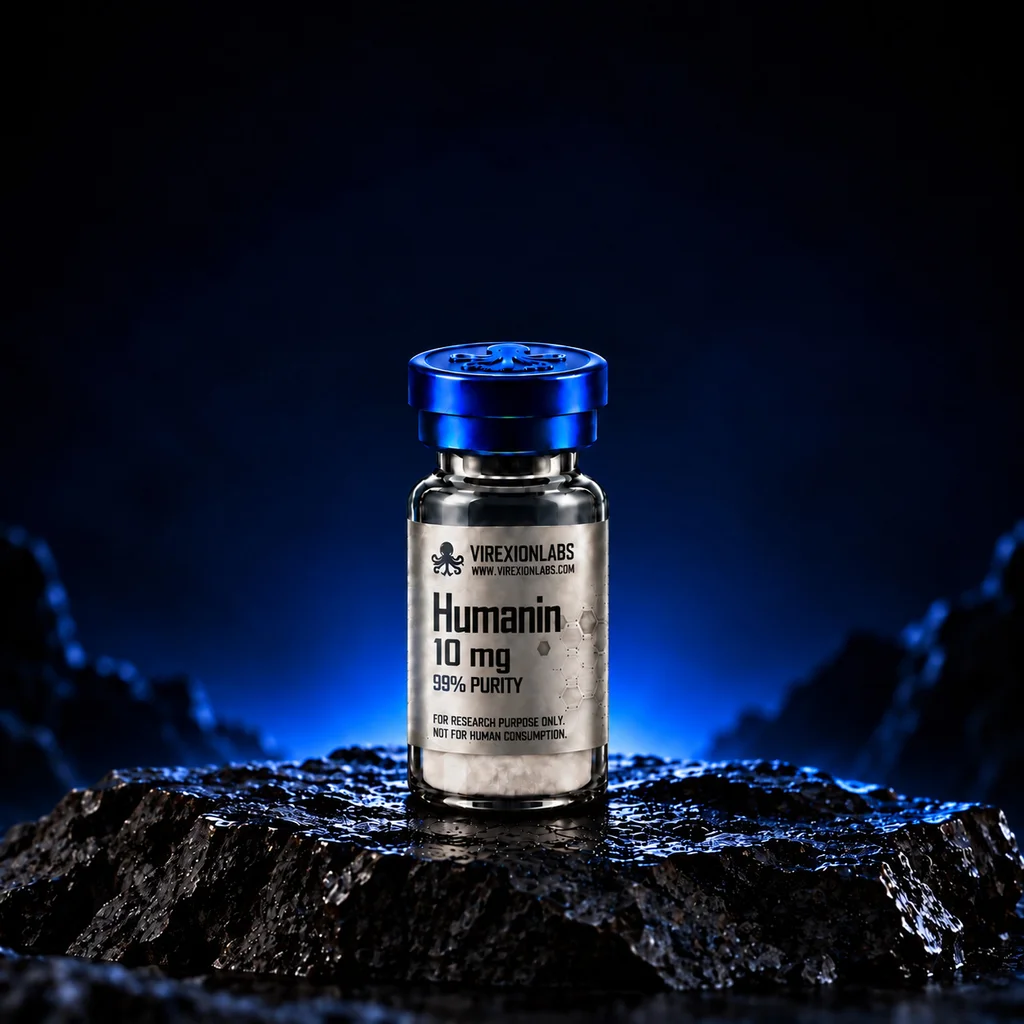
| Contents per vial | 10 mg |
|---|---|
| Form | Lyophilized powder |
| Packaging | Sealed glass vial |
| Purity | 99,62 % (HPLC) |
| Storage | 2–8 °C, keep dry and protect from light |
| Molecular formula | C119H204N34O32S2 |
| Molecular weight | 2687,23 g/mol |
| Sequence or structure | MAPRGFSCLLLLTSEIDLPVKRRA; 24 amino acids |
| CAS | 330936-69-1 |
| Intended use | For laboratory research only |
About this product
Humanin is a mitochondrial-derived peptide discovered in research to protect neurons from cellular stress. It is being investigated for cytoprotective, metabolic and neurobiological properties. Research includes mitochondrial function, insulin sensitivity, inflammation and mechanisms of aging. Humanin is of interest as part of a new group of mitochondrial signaling peptides.
What is Humanin?
Humanin is classified as a “synthetic peptide or peptide analogue” and is being evaluated in scientific research in areas such as cell protection against stress, neurons and neurodegeneration, glucose metabolism, mitochondria and aging. Attention is paid to its interaction with relevant receptors, enzymes or cellular pathways and subsequent changes in measurable laboratory parameters.
Mechanism of action under investigation
Humanin can act intracellularly and through membrane receptor complexes. Its influence on apoptosis, JAK/STAT signaling and mitochondrial stress response is investigated.
MAIN AREAS OF RESEARCH
• Protection of cells from stress: Humanin is a mitochondrial-derived peptide studied for its ability to support cell survival under metabolic and oxidative stress.
• Neurons and neurodegeneration: Research is devoted to the protection of nerve cells from toxic and degenerative stimuli, including mechanisms associated with amyloid.
• Glucose metabolism: Humanin is being investigated in relation to insulin signaling, insulin sensitivity and glucose regulation.
• Mitochondria and aging: As a mitochondrially encoded signal peptide, it is being investigated in relation to cellular energetics and the changes that accompany aging.
• Inflammation: Experimental works monitor the effect of Humanin on inflammatory signals that are activated during metabolic and tissue stress.
Research findings to date
Humanin is a mitochondrial-derived peptide discovered in research to protect neurons from cellular stress. Research includes mitochondrial function, insulin sensitivity, inflammation and mechanisms of aging. Data on adverse effects in humans are limited or depend on the specific research protocol. With experimental peptides, the risk of a local reaction, immunogenicity or an unpredictable biological response must also be taken into account; these possibilities cannot be considered a complete clinical list.